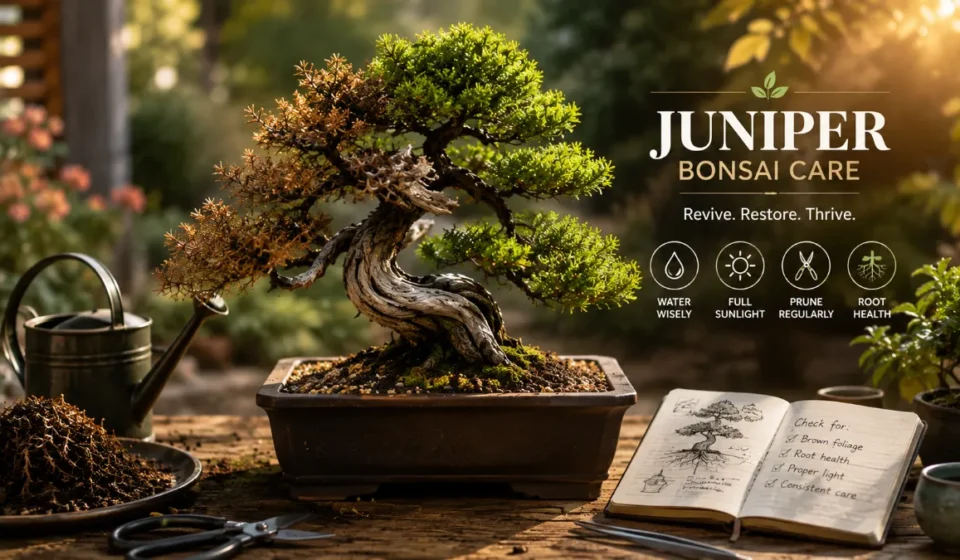

If your juniper bonsai is turning brown, losing foliage, or developing dead-looking branches, do not start by watering more or cutting everything back. Brown foliage is a symptom, not a diagnosis. The same visible decline can come from poor light, drought stress, excess moisture, root problems, pests, disease, or winter injury.
The most effective juniper bonsai care response is therefore diagnostic:
Check the location → inspect moisture → verify drainage → examine foliage and branches → look for pests or disease → correct the underlying problem → wait before major styling.
That sequence prevents panic treatments from creating additional stress.
Is the Juniper Actually Dead?
A brown tree is not automatically a dead tree.
Look for:
- Green foliage on some branches
- Flexible living branches
- Healthy sections of bark
- New growth
- Localized rather than complete dieback
- Roots that remain firm rather than dark and mushy
Do not expect dead foliage to turn green again. The question is whether enough living tissue remains for the tree to continue growing.
Why Brown Foliage Is Difficult to Diagnose
Juniper symptoms overlap.
University of Minnesota Extension separates juniper problems into several patterns, including tip browning, interior browning, yellow foliage, scale damage, and root rot.
That means:
Brown does not equal overwatering.
And:
Brown does not equal underwatering.
The surrounding evidence matters.
First Check: Has the Tree Been Indoors?
If your juniper has lived indoors for weeks or months, investigate that before changing the watering routine.
Junipers are outdoor bonsai. Bonsai Empire recommends bright outdoor placement throughout the year and seasonal protection during severe cold.
A room can look bright without providing the intensity of direct outdoor sunlight. Long-term indoor cultivation also removes the natural seasonal environment expected by a temperate conifer.
If the tree has been kept indoors, return it to an appropriate outdoor location.
How to Move a Stressed Indoor Juniper Outside
Do not interpret “move it outside” as “immediately expose a weak tree to every environmental extreme.”
Use a sensible outdoor position with:
- Strong but appropriate natural light
- Good airflow
- Reliable drainage
- Protection from severe weather
- Conditions suited to the local climate
Then observe the tree.
Recovery does not mean old brown foliage becomes green. A better sign is that remaining living sections stay healthy and the tree eventually produces viable new growth.
Diagnose Water Stress Before Watering Again
Watering is one of the most important parts of juniper bonsai care, but both too little and too much can cause problems.
Possible Underwatering
Investigate underwatering when:
- The substrate becomes completely dry
- The pot dries unusually fast
- Hot weather or strong wind is present
- The tree receives intense sun
- The foliage is declining while the root environment is consistently dry
A small bonsai container can lose moisture quickly in hot or windy conditions.
Possible Overwatering
Look instead for:
- Soil remaining wet for prolonged periods
- Poor drainage
- Persistent root-zone odor
- Declining foliage despite wet soil
- Dark, soft, mushy roots
University of Minnesota Extension specifically identifies dark, soft, mushy roots and heavy waterlogged soil with juniper root rot.
Penn State Extension also explains that prolonged excess moisture reduces oxygen availability around roots and can favor root-rot pathogens, including Phytophthora species affecting junipers.
A soft trunk base alone is therefore not enough to prove root rot.
Fix the Root Environment
If the substrate stays wet for too long, inspect the whole root environment.
Ask:
- Are drainage holes open?
- Does water escape freely?
- Is the substrate compacted or excessively water-retentive?
- Is the tree being watered again before it has begun to dry?
- Is the pot sitting inside standing water?
If the problem is persistent, the substrate may need attention.
When Repotting Makes Sense
Do not repot every declining juniper automatically.
Repotting can create additional stress and should have a clear reason, such as:
- Severely degraded substrate
- Poor drainage
- Significant root congestion
- Confirmed root problems
- A container that is no longer appropriate
Bonsai Empire gives approximately two years as a general repotting interval for junipers while noting that older trees can be repotted less frequently. It also advises against overly aggressive root pruning.
The tree’s root condition matters more than a calendar date.
Read the Browning Pattern
The most useful diagnostic question is not:
“Why are my needles brown?”
It is:
“Where does the browning begin, and what else is happening?”
| Symptom pattern | Possible explanation | What to investigate |
| Branch tips turn brown and then gray | Twig blight or other stress | Timing, branch pattern, fungal signs |
| Inner/lower foliage browns while tips remain green | Cercospora-type disease, shading, or other stress | Foliage density and disease symptoms |
| White spots on needles | Juniper scale | Inspect closely for scale coverings |
| Brown tips plus waterlogged soil | Root stress/root rot possible | Inspect drainage and roots |
| Brown woody galls with orange growth | Rust disease | Examine galls and wet-weather symptoms |
| Purplish-brown foliage during frost | Normal cold response in some junipers | Season and overall tree condition |
Extension guidance shows why symptom location matters: Phomopsis and Kabatina tip blights begin at branch tips, while Cercospora affects inner and lower foliage first.
Juniper Scale: Look Closely Before Treating
Juniper scale can be easy to overlook because the insects are small.
University of Minnesota Extension describes white, spot-like coverings on needles, while Penn State’s updated 2026 guidance identifies Carulaspis juniperi and Carulaspis minima as juniper and minute cypress scales. Heavy infestations can cause yellowing, needle loss, branch dieback, and potentially severe plant decline.
If you suspect scale:
- Inspect needles and stems closely.
- Look for characteristic coverings.
- Check whether foliage is becoming dull or yellow.
- Confirm the pest before selecting treatment.
Do not automatically spray neem oil or another pesticide simply because the foliage looks unhealthy.
Treatment Should Follow Identification
Pesticides should be chosen for the actual pest and used according to the product label.
Penn State notes that natural enemies can help suppress scale and that treatment timing matters because crawler stages are more vulnerable to some controls.
That is much more useful than telling every struggling juniper owner to spray the same product.
Rust: A Distinctive Symptom Pattern
Rust diseases can be confused with generic browning if you do not know what to look for.
Cedar-apple rust can produce brown, round woody galls on juniper twigs. During wet spring weather, bright orange, gelatinous structures can emerge from those galls. Other juniper rusts produce their own characteristic swellings, galls, or orange structures.
So:
Orange-brown foliage alone does not establish rust.
Look for the characteristic structures on the branches.
Penn State identifies cedar-apple, cedar-hawthorn, cedar-quince, and related rust diseases among important juniper diseases.
Twig Blight and Tip Dieback
If branch tips suddenly brown and remain dead while the rest of the plant stays green, investigate twig blight.
University of Minnesota Extension describes Phomopsis and Kabatina blights as diseases that affect branch tips, with differences in timing and symptom development.
Penn State similarly lists both Kabatina and Phomopsis twig blights among juniper diseases.
This is why a generic “improve airflow and spray neem oil” response is inadequate. These are not insect problems.
Do Not Style a Tree That Is Still Declining
One of the most important recovery rules is:
Health first, styling second.
When a juniper is seriously stressed, avoid major cosmetic pruning, heavy wiring, unnecessary repotting, or aggressive shaping.
Remove material only when there is a clear reason.
Why Over-Pruning Can Make Things Worse
Junipers cannot reliably regenerate from completely bare old sections. If you remove healthy foliage from a branch you want to preserve, you may remove the growth needed for that branch to remain viable.
Wait for the tree to stabilize before attempting major redesign.
When to Resume Wiring
Once the tree is growing steadily again, wiring can return as a structural technique.
Junipers are particularly suitable for dramatic wiring, but deadwood can be brittle and major bends require protection and careful technique.
Inspect wired branches regularly and remove wire before it cuts into expanding tissue.
A Conservative Recovery Plan
Use this sequence when the cause is not immediately obvious.
Step 1: Correct the Location
If the tree has been indoors, return it to an appropriate outdoor environment.
Step 2: Assess the Light
Confirm that the new location actually receives strong natural light.
Step 3: Check Moisture
Do not water automatically. Determine whether the substrate is too dry, appropriately drying, or remaining saturated.
Step 4: Verify Drainage
Make sure excess water can leave the container freely.
Step 5: Inspect the Tree
Look at needles, stems, branch tips, roots if accessible, and the trunk.
Step 6: Identify Pests or Disease
Look for scale, webbing, galls, unusual lesions, or characteristic dieback patterns.
Step 7: Make the Smallest Necessary Correction
Avoid changing five variables at once.
Step 8: Wait and Observe
A living tree needs time to respond.
Step 9: Resume Styling Only After Stability Returns
New healthy growth is a useful positive sign, but the overall trend matters more than one isolated shoot.
What Not to Do
When a juniper looks sick, avoid these common reactions:
- Watering repeatedly without checking the substrate
- Adding heavy fertilizer
- Moving it between several locations every day
- Cutting away large amounts of green foliage
- Repotting without a root-zone reason
- Spraying pesticides without identifying the pest
- Assuming all brown foliage has one cause
- Keeping the tree indoors because it appears fragile
The more variables you change simultaneously, the harder it becomes to determine what actually helped.
Seasonal Recovery
Recovery also depends on the time of year.
Spring
Watch for healthy new growth and increasing activity. Inspect regularly for pests and adjust watering as the tree’s demand rises.
Summer
Monitor moisture more closely during hot, windy conditions. A balcony-grown bonsai may dry much faster than one in a sheltered courtyard.
Autumn
Prepare the tree for changing temperatures and reduced growth. Identify a suitable sheltered location before severe winter weather arrives.
Winter
Junipers need seasonal cold, but severe exposure can damage roots in shallow containers.
Bonsai Empire recommends additional winter protection below approximately 15°F (-10°C). This is a guideline rather than a universal survival threshold because species, acclimation, wind, container size, and local climate affect cold tolerance.
Some junipers naturally develop purplish-brown foliage during frost as part of their cold response.
Do not confuse that temporary coloration with progressive disease without considering the season and the rest of the tree.
Restyling a Recovered Juniper
Once the tree has stable growth, juniper bonsai care can again include aesthetic development.
Informal Upright
Works well in restrained displays where the trunk and canopy remain clearly visible.
Cascade
Benefits from elevation and open space below the descending branches.
Windswept
Needs negative space around the direction of movement so the design remains readable.
Jin and Shari
Juniper deadwood can create dramatic age and weathering effects. These features are best developed gradually and only when the tree is healthy enough for additional styling work.
Read more: Juniper Bonsai Dying? A Diagnostic Care Guide to Save, Recover, and Restyle Your Tree
The Best Display After Recovery
A recovered juniper does not need to return immediately to an elaborate display.
Start with:
- A stable outdoor position
- Strong natural light
- Appropriate moisture
- A simple pot
- An uncluttered stand
- Enough negative space around the tree
Once the tree is clearly stable, occasional indoor display can be introduced for short periods.
That keeps the decorative goal from becoming another source of stress.
Frequently Asked Questions
Why is my juniper bonsai turning brown?
Possible causes include poor light, drought stress, excess moisture, root problems, pests, disease, and winter injury. Some junipers also develop temporary purplish-brown coloration during frost. Diagnose the pattern rather than assuming one cause.
Is my juniper bonsai dead if the foliage is brown?
Not necessarily. Check for living, flexible branches and healthy remaining sections. Brown foliage itself will not become green again, but a tree with viable living tissue may recover.
Can a juniper bonsai recover after being kept indoors?
It can recover if enough living tissue remains and the growing conditions are corrected. Move it to a suitable outdoor location and give it time. Recovery is possible, not guaranteed.
Should I water a dying juniper bonsai more often?
No. First inspect the substrate. If it is already wet, additional watering can worsen root stress. If it is genuinely dry, water thoroughly and then monitor the moisture rather than following a fixed schedule.
How do I know if my juniper has root rot?
Waterlogged soil combined with dark, soft, mushy roots is strong evidence of root rot. Brown foliage alone is not enough to make that diagnosis.
Should I repot a sick juniper bonsai?
Only when there is a clear reason such as poor drainage, severely degraded substrate, serious root congestion, or confirmed root problems. Unnecessary repotting adds stress.
What does juniper scale look like?
Juniper scale can appear as small white, spot-like coverings on needles. Heavy infestations may cause dull foliage, yellowing, needle loss, and branch dieback.
What does cedar-apple rust look like on juniper?
Characteristic signs include brown woody galls on twigs and bright orange gelatinous structures emerging during wet spring weather.
When should I prune a recovering juniper?
Wait until the tree is stable and producing healthy growth before major styling. During active decline, limit pruning to material that genuinely needs removal and retain healthy foliage on important branches.
Can I display a recovering juniper bonsai indoors?
It is better to minimize unnecessary indoor display while the tree is weak. Once healthy growth is established, a short indoor display can be acceptable, but the tree’s normal environment should remain outdoors.
Final Takeaway
A dying-looking juniper rarely needs a mystery treatment. It needs a better diagnosis.
Start with location and light. Then inspect moisture and drainage. After that, examine the foliage, branches, roots, pests, and disease symptoms. Correct the most likely underlying problem and avoid making multiple major changes at once.
Most importantly, separate recovery from styling.
A stressed tree does not need a dramatic haircut, elaborate wiring, or a new decorative pot. It needs stable conditions and time. Once healthy growth returns, you can gradually rebuild its shape and turn it back into the centerpiece it was meant to be.
The strongest juniper bonsai care routine is therefore not the one with the most interventions. It is the one that identifies the problem accurately, makes the smallest necessary correction, and gives the tree enough time to respond.