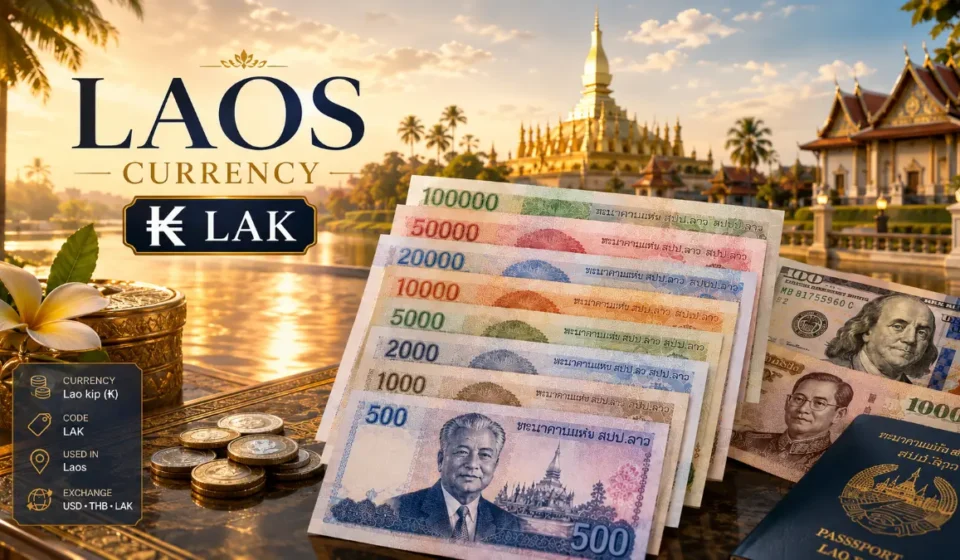

If you are searching for Laos currency, the answer is simple: Laos uses the Lao kip, the country’s official currency. Its international currency code is LAK, and its commonly used symbol is ₭. For travelers, however, knowing the name is only the beginning. You also need to understand the banknotes, exchange rates, use of U.S. dollars and Thai baht, ATM and card payments, and how to avoid carrying more kip than you can use.
This guide explains Laos currency in practical terms, using current information from the Bank of the Lao P.D.R. (BOL), Laos’s tourism authority, and the World Bank. Because exchange rates, inflation, payment availability, and banking conditions can change, time-sensitive figures below are identified by date rather than presented as permanent facts.
Laos Currency at a Glance
The most important facts about Laos currency can be understood at a glance:
| Currency Detail | Information |
| Official currency | Lao kip |
| Country | Laos / Lao People’s Democratic Republic |
| ISO 4217 code | LAK |
| Symbol | ₭ |
| Central bank | Bank of the Lao P.D.R. |
| Subunit | Att |
| Banknotes listed by Laos tourism authorities | 500, 1,000, 2,000, 5,000, 10,000, 20,000, 50,000 and 100,000 kip |
| Highest denomination listed | 100,000 kip |
| Useful foreign currencies for exchange | USD, EUR and THB |
| Main everyday payment method | Cash in kip |
The Lao tourism authority identifies the kip as the official currency and lists the eight banknote denominations above. It also identifies U.S. dollars, euros, and Thai baht as useful currencies for exchanging into kip.
The distinction between the local currency and foreign-currency acceptance is important. The Lao kip is the official currency; USD or THB may be accepted by particular businesses, but that does not make them official Lao currencies.
What Is the Lao Kip?
The Lao kip is the national currency of Laos and is issued under the authority of the Bank of the Lao P.D.R., the country’s central bank.
Its international code is LAK, which is the identifier you will normally see on currency converters, banking applications, financial websites, and exchange-rate tables. The symbol ₭ is used to represent the kip in written prices.
The kip is divided into 100 att, but the att is no longer important for ordinary modern transactions. Travelers generally deal with whole-kip prices and banknotes rather than att.
The modern kip also has a complicated history. Laos has used several forms of the kip during different political periods, so saying that the name has existed for decades does not mean today’s banknotes are simply unchanged versions of the currency first introduced in the 1950s.
For a traveler, the practical rule is easy: if a price is quoted in LAK or kip, it refers to Laos’s local currency.
Lao Kip Symbol and Currency Code
The two identifiers most useful to understand are ₭ and LAK.
₭ is the currency symbol, while LAK is the ISO 4217 code used internationally.
For example:
- ₭10,000 = 10,000 Lao kip
- ₭50,000 = 50,000 Lao kip
- ₭100,000 = 100,000 Lao kip
When searching for an exchange rate, LAK is generally more useful than the symbol because banks and financial platforms use standardized currency codes.
The historical subunit is the att, with 100 att equal to one kip. Because very small denominations are no longer practical in everyday commerce, visitors should not expect to make ordinary purchases using att.
Lao Kip Banknotes and Denominations
Banknotes are the main form of physical money travelers will encounter. The Laos tourism authority currently lists these denominations:
| Banknote | Typical practical use |
| 500 kip | Very small-value transactions |
| 1,000 kip | Small purchases |
| 2,000 kip | Small everyday payments |
| 5,000 kip | Small to moderate purchases |
| 10,000 kip | Everyday spending |
| 20,000 kip | General-purpose spending |
| 50,000 kip | Larger purchases |
| 100,000 kip | Highest listed denomination |
The 100,000-kip note is the highest denomination listed in the tourism authority’s current public currency guidance.
The value of individual notes should not be confused with their age or design. Different issues of banknotes can circulate, and a newer edition of an existing denomination does not necessarily mean the older denomination has become invalid.
Why Lao Prices Have So Many Zeros
One of the first things visitors notice about Laos currency is the size of the numbers on price tags.
A price of 100,000 kip may look enormous to someone unfamiliar with the currency, but the number of currency units does not by itself tell you whether something is expensive.
Using the Bank of the Lao P.D.R.’s reference rate of 22,310 LAK per U.S. dollar on August 28, 2026, for example:
| Amount | Approximate USD value |
| ₭100,000 | $4.48 |
| ₭500,000 | $22.41 |
| ₭1,000,000 | $44.82 |
| ₭2,000,000 | $89.65 |
These are mathematical conversions from a dated official reference rate, not guaranteed amounts that a traveler will receive when exchanging cash or withdrawing money.
The useful habit is to develop a rough mental conversion rather than judging a price by the number of zeros.
Are Coins Used in Laos?
Coins have existed in Lao monetary history, including small att-denominated coins, but they are not an important part of ordinary modern cash transactions.
For practical travel purposes, expect banknotes rather than coins when making everyday cash purchases.
This distinction matters because older online currency pages sometimes mix historical or commemorative coins with money that travelers are likely to encounter in normal commerce today. The current Laos tourism guidance focuses on banknotes ranging from 500 to 100,000 kip.
Laos Currency Exchange Rate and Current Value
The value of Laos currency against the U.S. dollar and other currencies changes over time, so an exchange rate should always be treated as time-sensitive information.
The Bank of the Lao P.D.R. listed a reference rate of 22,310 kip per U.S. dollar on August 28, 2026. On the same date, BOL listed USD buying and selling rates of 22,303 and 22,515 kip per U.S. dollar, respectively.
That produces these approximate conversions:
| U.S. Dollars | Kip at 22,310 LAK/USD |
| $1 | ₭22,310 |
| $5 | ₭111,550 |
| $10 | ₭223,100 |
| $20 | ₭446,200 |
| $50 | ₭1,115,500 |
| $100 | ₭2,231,000 |
The date matters. The BOL reference rate was 22,326 LAK/USD on August 27 and 22,310 LAK/USD on August 28, demonstrating why an article should not present one exchange rate as permanently current.
If you are exchanging money today, check the latest BOL information or the actual rate offered by your bank, exchange provider, card network, or ATM.
Reference Rate vs. the Rate You Actually Receive
A common mistake is to assume that the official reference rate is exactly what a traveler will receive.
It is not necessarily.
A provider can quote separate buying and selling rates, add a fee, or incorporate a spread into its price. Your card issuer may also charge an international transaction fee.
For example, if the reference rate is 22,310 kip per dollar, you should not assume that handing over $100 will automatically produce exactly ₭2,231,000.
When comparing exchange options, look at the final amount of kip you will receive after fees, not only the headline rate.
Why Has the Lao Kip Lost Value?
The recent history of the kip is closely connected with Laos’s broader economic pressures.
The country has faced substantial external debt obligations, foreign-exchange constraints, imported fuel costs, and periods of very high inflation. These pressures became especially serious in the early 2020s.
The World Bank reported severe currency depreciation and inflationary pressure during 2023. More recent evidence shows a more mixed picture: economic conditions improved during 2025 and early 2026, inflation slowed from its earlier peaks, and international reserves increased, but Laos remains vulnerable to external shocks and continues to face elevated debt and limited fiscal space.
The Bank of the Lao P.D.R. reported 7.60% year-on-year inflation for July 2026. Its published data show that inflation had fallen considerably from the very high levels seen earlier in the decade, although price pressures remained significant.
That makes the recent currency story more nuanced than simply saying that the kip is “collapsing.” Laos has experienced severe monetary pressure, followed by periods of greater stability, while important structural vulnerabilities remain.
Using Laos Currency as a Traveler
For most visitors, the practical question is not how the kip evolved historically but how to pay for things once you arrive.
A useful strategy is to treat payment methods as complementary rather than choosing only one.
| Travel situation | Usually the most practical option |
| Local market | Kip cash |
| Street food | Kip cash |
| Small restaurant | Kip cash |
| Local transportation | Kip cash |
| Larger hotel | Card or another accepted payment method |
| Upscale restaurant | Card may be available |
| Rural travel | Carry sufficient cash |
| ATM withdrawal | Useful where a suitable machine is available |
| Foreign-currency exchange | Compare the final amount received |
The exact payment experience varies by merchant, city, tourism area, bank, and card network. The Laos tourism authority states that major cards are accepted mainly at larger hotels, restaurants, and souvenir shops in major cities such as Vientiane and Luang Prabang.
How Much Cash Should You Carry?
There is no universally correct amount.
Your cash needs depend on where you are staying, how much time you will spend outside major cities, your transportation arrangements, and how often you expect to use ATMs or cards.
A better strategy than carrying a huge amount at once is to maintain enough cash for your expected daily spending plus a reasonable emergency buffer.
This reduces two risks at the same time:
- running out of cash where cards are unavailable;
- ending your trip with far more kip than you can conveniently spend.
Can You Use U.S. Dollars in Laos?
Yes, U.S. dollars can be useful in Laos, particularly for exchanging into kip and for some larger or tourism-related transactions.
The Laos tourism authority specifically identifies U.S. dollars as one of the useful currencies for exchange.
However, USD is not the official currency of Laos.
Whether a business accepts dollars depends on the establishment and transaction. A hotel or tour operator may handle USD differently from a small restaurant, market stall, or local transport provider.
If a merchant accepts dollars, ask which exchange rate is being used when the difference could materially affect the final price. For ordinary small purchases, paying in kip is often simpler because the price and change are already expressed in the local currency.
Can You Use Thai Baht in Laos?
Thai baht is particularly relevant because Thailand borders Laos and the baht is an important regional currency.
The Bank of the Lao P.D.R. publishes THB exchange information, and the Laos tourism authority identifies Thai baht as one of the useful foreign currencies for exchange.
That does not mean every Lao merchant will accept baht or use the same conversion rate.
If you are near a border area or dealing with a business accustomed to international visitors, THB may be useful. For ordinary purchases where you have a choice, kip remains the safest default.
Are Credit Cards and Debit Cards Accepted?
Card acceptance is available but uneven.
The official Laos tourism guidance says Visa, Mastercard, and American Express are accepted mainly at larger hotels, restaurants, and souvenir shops in large cities.
In practical terms, that means a traveler should not assume that a card will work everywhere.
Cards are more useful as a payment option at established businesses, while cash remains important for smaller purchases and locations where card infrastructure is limited.
A sensible payment setup is:
- Primary: Lao kip cash
- Secondary: debit or credit card
- Backup: another card or another accessible source of funds
This approach provides flexibility if a terminal, ATM, bank network, or individual merchant cannot process your preferred payment method.
How Do ATMs Work in Laos?
ATMs can be useful for obtaining kip, particularly in larger cities and established tourist destinations. However, ATM availability, supported cards, withdrawal limits, and fees can vary by bank and machine.
For that reason, avoid relying on an old article that says every ATM charges the same fee or allows the same withdrawal amount.
Before confirming a withdrawal, check:
- the withdrawal amount;
- any local ATM fee;
- the exchange-rate option;
- the final amount that will be charged;
- whether the ATM offers currency conversion.
Your own bank may also impose a separate international withdrawal or foreign-exchange fee.
What Is Dynamic Currency Conversion?
An ATM or payment terminal may offer to convert a transaction into your home currency instead of charging you in the local currency.
When given that choice, selecting kip generally avoids allowing the ATM or merchant’s conversion service to determine the exchange rate. Your card issuer or payment network then handles the currency conversion according to its applicable terms.
This does not guarantee that the overall transaction will be fee-free, but it avoids accepting an unnecessary third-party currency conversion without first seeing what rate is being offered.
Where Can You Exchange Money in Laos?
The Laos tourism authority identifies banks, airports, and foreign-currency exchange offices as places where travelers can exchange foreign currency.
There is no universal rule that one type of exchange location will always provide the best rate. Conditions can change by provider, currency, location, and day.
When comparing two options, focus on the amount of kip you will actually receive after fees.
For a large exchange, even a modest difference in the effective rate can matter. For a small exchange, convenience may reasonably be more important than a tiny difference.
What Currency Should You Carry in Laos?
The best approach for most travelers is not to choose between kip, foreign cash, and cards as if only one can be used.
Instead, use each for the situation where it is most practical.
| Payment option | Best use | Main limitation |
| Lao kip | Everyday purchases | Mainly useful within Laos |
| USD | Backup and exchange | Not accepted everywhere |
| THB | Regional/border-related travel | Merchant acceptance varies |
| Credit/debit card | Larger established businesses | Not universally accepted |
| ATM | Getting local cash | Fees and availability vary |
This layered approach is more useful than carrying an unnecessarily large amount of any single currency.
What Should You Do With Leftover Kip?
Managing leftover kip is easy to overlook when planning a trip.
Because the kip is primarily useful within Laos, it makes sense to avoid a large final withdrawal simply because an ATM permits it.
Before leaving, estimate what you still need for:
- food;
- local transportation;
- shopping;
- entrance fees;
- airport or border expenses;
- unexpected costs.
Then obtain only a reasonable additional amount.
If you already have excess cash, using it for legitimate final purchases is generally more practical than leaving the country with a large balance that may be difficult to use elsewhere.
Laos Currency and the Economy in 2026
The current economic context helps explain why exchange-rate information needs to be treated as dynamic.
The World Bank’s June 2026 assessment says economic conditions and growth improved in 2025 and early 2026, while emphasizing that the improvement remains fragile. It also identifies elevated public and publicly guaranteed debt, limited fiscal space, external shocks, fuel costs, and foreign-exchange constraints as continuing vulnerabilities.
At the same time, the BOL’s July 2026 inflation figure was 7.60%, considerably below the exceptionally high inflation experienced during the earlier crisis period.
This context matters because exchange rates are not isolated numbers. Inflation, foreign-exchange availability, debt servicing, imported fuel costs, trade conditions, and investor confidence can all influence the environment in which a currency operates.
For travelers, however, the practical conclusion is straightforward: always check the current exchange rate close to the date you need it.
Is the Lao Kip a Weak Currency?
Against the U.S. dollar, the kip has experienced substantial depreciation in recent years. But the number of kip required to buy one dollar does not, by itself, tell you whether the Lao economy is “strong” or “weak.”
Currency comparisons require broader context, including inflation, productivity, trade, interest rates, foreign-exchange conditions, public finances, and other economic factors.
For someone planning a trip, the more useful question is:
How much will my money buy in Laos, and what rate and fees will apply when I exchange or spend it?
That question directly affects a travel budget, whereas a label such as “strong currency” or “weak currency” can oversimplify a complicated economic situation.
Read more: Laos Currency: The Complete Guide to the Lao Kip
Laos Currency: Practical Tips Before You Travel
A few simple habits can make handling money in Laos much easier.
- Learn the major kip denominations before your trip. Large numbers become less intimidating once you recognize the notes.
- Keep some local cash available. Do not assume every business accepts cards.
- Use a current exchange rate. A rate from several weeks or months ago may no longer be useful.
- Compare the final exchange amount. A headline rate can hide fees or spreads.
- Be cautious with dynamic currency conversion. If an ATM offers to charge you in your home currency, compare the option carefully.
- Keep a backup payment method. A second card can be useful if one fails.
- Avoid excessive final withdrawals. Leftover kip is less useful outside Laos.
- Do not confuse foreign-currency acceptance with official currency status. Kip remains the country’s official currency.
Frequently Asked Questions
What is the currency of Laos?
The official currency of Laos is the Lao kip. Its international currency code is LAK, and its commonly used symbol is ₭.
What is the Laos currency code?
The ISO 4217 code for the Lao kip is LAK. Banks, currency converters, financial websites, and payment systems commonly use this code.
What is the symbol for Lao kip?
The Lao kip uses the ₭ symbol. LAK is the standardized international currency code and is generally more useful when searching for exchange rates.
What banknotes are used in Laos?
The Laos tourism authority lists 500, 1,000, 2,000, 5,000, 10,000, 20,000, 50,000, and 100,000 kip banknotes in circulation.
What is the current USD to LAK exchange rate?
The Bank of the Lao P.D.R. listed a reference rate of 22,310 LAK per USD on August 28, 2026. Because exchange rates change, travelers should check the latest BOL rate and the actual rate offered by their provider before exchanging money.
Can I use U.S. dollars in Laos?
U.S. dollars are useful for exchanging into kip and may be accepted for certain larger or tourism-related transactions. However, acceptance varies by business, and the kip remains the official local currency.
Can I use Thai baht in Laos?
Thai baht is an important regional currency and can be exchanged in Laos. Some businesses may also accept it, but merchant acceptance and exchange rates vary. For ordinary spending, kip is the more dependable choice.
Are credit and debit cards accepted in Laos?
Cards are accepted mainly at larger hotels, restaurants, and shops in major cities, according to Laos tourism guidance. Smaller businesses and locations outside major centers may rely more heavily on cash.
Are coins commonly used in Laos?
Historical Lao coins exist, but coins are not an important part of ordinary modern cash transactions. Travelers should generally expect to use banknotes.
Why has the Lao kip depreciated?
The kip has faced pressure from external debt, foreign-exchange constraints, imported fuel costs, and high inflation. Conditions improved during 2025 and early 2026, but the World Bank continues to identify significant structural vulnerabilities in the Lao economy.
Final Takeaway
Understanding Laos’s currency is much easier once you separate three questions: What is the currency, what is it worth today, and how should you use it while traveling?
The official currency is the Lao kip (LAK), represented by ₭. Laos’s tourism authority currently lists banknotes from 500 through 100,000 kip, while the Bank of the Lao P.D.R. provides the country’s official exchange rate and inflation data.
For travelers, kip is the most practical currency for everyday local spending. USD and THB can be useful for exchange or certain transactions, while cards provide another option at larger establishments. Because payment acceptance and fees vary, a combination of local cash, a card, and a backup payment method is more reliable than depending on one method alone.
The latest official BOL reference rate available for August 28, 2026, was 22,310 LAK per U.S. dollar, but that figure should be treated as a dated reference rather than a guaranteed traveler rate.
The broader economic picture is also more nuanced than simply calling the kip “weak.” Laos has experienced severe inflation and currency pressure, but recent indicators show improved stability alongside continuing debt and external vulnerabilities.
For anyone traveling to Laos, the practical formula is simple: carry enough kip for everyday purchases, keep a dependable payment backup, compare the actual cost of currency conversion, check current rates before major exchanges, and avoid withdrawing far more cash than you expect to spend.