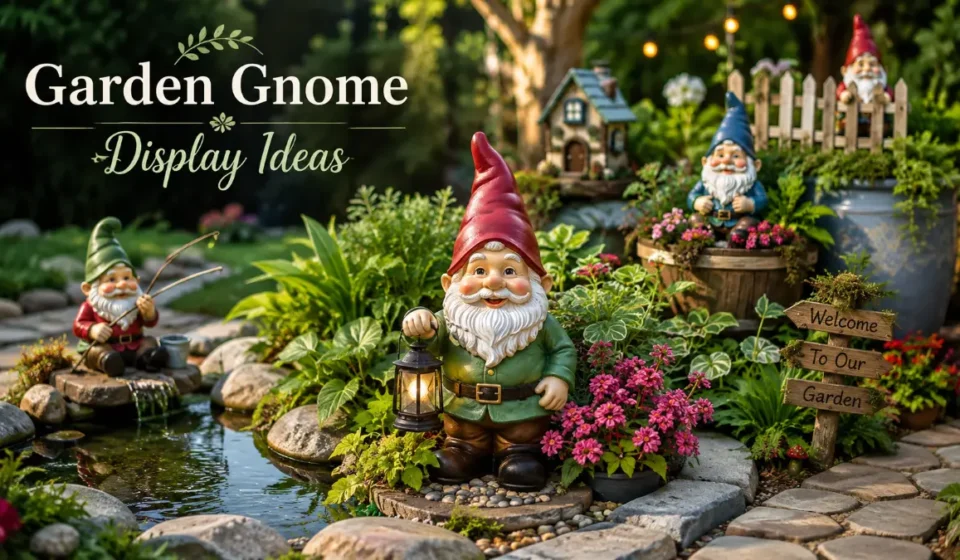

Garden Gnomes can be a tiny focal point, a hidden surprise, part of a miniature scene, or simply a humorous detail beside a favorite plant. The difference between an enjoyable display and visual clutter usually comes down to the setting around the figure.
Instead of treating a gnome as something that automatically belongs in the middle of a lawn, think about what the surrounding garden can contribute: foliage can provide a frame, a path can create direction, a pond can establish a story, and seasonal planting can change the scene without requiring a new ornament.
1. The Partly Hidden Flower-Bed Gnome
Place a figure behind the front edge of a planting bed so that foliage conceals part of its body.
The goal is not to hide the entire ornament. Leave the face, hat, or upper body visible enough to attract attention.
This works particularly well with:
- hostas;
- ornamental grasses;
- low shrubs;
- fern-like foliage; and
- informal flowering borders.
The planting should frame the figure rather than swallow it.
2. The Pathside Discovery
Position a small figure just beyond the edge of a garden path.
A visitor should notice it while walking past rather than seeing it immediately from across the entire property.
This is especially effective in larger gardens because it creates a sequence of small discoveries. One figure can mark a bend, another can appear near a planting bed, and a third can occupy a destination at the end of the path.
Do not put ornaments where they interfere with walking, mowing, drainage, or maintenance.
3. The Entryway Greeter
A medium-sized traditional figure can create a welcoming detail near a gate or front garden.
Place it slightly to one side rather than directly in the center of the entrance. This preserves the visual path toward the door while allowing the figure to act as an accent.
A planter or low planting behind it can provide additional scale.
4. The Container Garden Character
Small spaces do not need to be excluded from the fun.
Use one compact figure in a large planter, provided the ornament and planting are compatible with the container’s purpose.
A trailing plant can partially frame the figure while upright foliage can create height behind it.
For edible containers, keep the ornament out of the growing area and avoid placing unsuitable coatings or materials directly against edible crops.
5. The Two-Viewpoint Display
Choose a location that can be seen from two different places-for example, from a patio and a kitchen window.
Then position the figure so that it remains visually interesting from both directions.
This can be more effective than designing a display for a single photograph.
Before finalizing the location, stand in both viewing positions and check:
- visibility;
- scale;
- surrounding clutter;
- plant growth;
- sunlight;
- and access for maintenance.
6. The Rockery Resident
A weathered or restrained figure can be integrated into a rockery rather than placed on top of the largest stone.
Use the existing rocks to establish scale. The figure should occupy a small “space” within the rockery rather than compete with the entire formation.
This approach also echoes an important part of the object’s British history: Sir Charles Isham incorporated imported gnomes into the rockery at Lamport Hall in 1847, positioning them among caves and crevices as though they were mining.
7. The Pondside Fisher
A fishing-themed figure can turn the edge of a pond into a miniature story.
Place the character a safe distance from the water on stable ground. Rocks, marginal planting, or a low path can provide a visual transition.
The ornament should never obstruct access to the pond for cleaning or maintenance.
8. The Birdbath Attendant
Put a small figure near-but not directly against-a birdbath.
The character can appear to be watching the birds or tending the feature.
Leave enough space to remove and clean the birdbath without moving the entire display. This practical detail is easy to overlook when designing purely for appearance.
The decorative figure should also remain outside the water itself.
9. The Herb-Garden Helper
A small gardener-themed character can fit naturally at the edge of an herb bed.
Place it where it does not interfere with harvesting, watering, weeding, or plant growth.
The strongest version is usually subtle: one figure at a corner rather than several figures scattered through the bed.
10. The Miniature Village Corner
If you own several figures, give them a dedicated location.
A village can occupy:
- a tree base;
- a raised bed corner;
- a rockery;
- a large container;
- or a small unused section of the garden.
Start with a path, two or three figures, and one or two structures. Expand only if the composition still has breathing room.
A defined boundary is what separates a miniature village from random ornaments.
11. The Gnome Pathway
Create a miniature route using gravel, flat stones, or another suitable small-scale material.
Position figures at different points along the route rather than placing them in a straight line.
Give the path somewhere to go: a tiny door, bridge, planter, house, or other focal object.
This works because the viewer can mentally follow the scene.
12. The Recycled Miniature House
Use suitable reclaimed objects to construct a tiny shelter.
Potential starting materials include:
- small terracotta pots;
- weather-suitable containers;
- hollow logs;
- reclaimed timber pieces; and
- other stable outdoor objects.
Check every item for sharp edges, unstable parts, toxic coatings, or poor weather resistance before placing it outside.
The most convincing DIY structures are usually simple rather than overloaded with tiny decorations.
13. The Fairy-Garden Crossover
Combine a few gnomes with miniature doors, mushrooms, bridges, furniture, or other fantasy elements.
The crucial design rule is scale consistency.
If the figure, door, chair, fence, and path all appear to belong to roughly the same miniature world, the scene feels intentional.
If every object is a different scale, the display can look like unrelated decorations collected in one place.
14. The Seasonal Window Display
Place one figure where it can be seen from a frequently used window.
Then let the planting around it change throughout the year.
Spring flowers can provide a soft frame. Summer foliage can create a lush backdrop. Autumn can introduce warm colors. Winter can rely on evergreen material.
This makes the display rewarding even when you are looking at the garden from indoors.
15. The Spring Emergence Scene
Use early-season planting to make the figure appear gradually as the garden wakes up.
Rather than choosing plants solely because they appear in a list of “gnome plants,” select species suited to your local climate, soil, moisture, and light.
The visual principle is more important than a particular plant:
Let new growth frame the figure rather than simply surrounding it with flowers.
16. The Summer Foliage Hideaway
Summer does not require additional props.
Let large foliage create the scene.
A figure placed near ferns, grasses, broad-leaved plants, or other suitable summer growth can become partly concealed as the season progresses.
This has a useful advantage: the display changes naturally as the plants mature.
17. The Autumn Harvest Scene
Give one character an autumn setting using a small number of seasonal elements.
Pumpkins, gourds, dried foliage, or an appropriate miniature wheelbarrow can establish the theme.
Avoid covering the entire area with props. One figure and two or three supporting elements are often enough.
Remove organic material once it begins to rot rather than allowing it to become a source of mess or unwanted pests.
18. The Winter Evergreen Nook
Create a small winter composition around one weather-appropriate figure.
Use evergreen branches, a container of winter planting, or other suitable seasonal material.
Outdoor-rated decorative lighting can provide evening interest, but cables should never cross paths or create trip hazards.
For figures that are vulnerable to freezing conditions, follow the manufacturer’s winter-storage recommendations rather than leaving them outside purely for seasonal decoration.
19. The One-Gnome-Four-Seasons Display
Choose one figure and never move it.
Instead, change the setting.
| Season | Surrounding treatment |
| Spring | Fresh foliage and early flowering plants |
| Summer | Dense green planting and grasses |
| Autumn | Pumpkins, gourds or warm foliage |
| Winter | Evergreen material and suitable outdoor lights |
This is one of the best approaches for a small garden because it produces variety without requiring additional ornaments.
It also creates continuity. The figure becomes part of the garden rather than a temporary seasonal purchase.
20. The Deliberately Funny Focal Point
Novelty figures work best when the humor has a clear location.
A gardening character can sit near a vegetable bed. A fishing figure can go beside a pond. A reading character can sit near a bench. A humorous holiday figure can occupy a seasonal corner.
The important thing is to avoid distributing unrelated jokes across the entire garden.
One strong comic detail is usually easier to control than a collection of competing novelty themes.
How to Design a Gnome Display Without Clutter
The easiest way to improve almost any display is to establish a hierarchy.
Ask:
What should I notice first?
If the answer is the gnome, keep the surrounding objects quieter.
If the answer is a flowering shrub, pond, sculpture, or architectural feature, use the figure as a supporting detail rather than another focal point.
Use the Three-Layer Principle
A successful miniature display often has three visual layers:
- Background – wall, hedge, tree, fence, or larger foliage.
- Main subject – the gnome or principal ornament.
- Foreground – low planting, gravel, stones, or path.
This is not a rigid gardening rule. It is simply a useful way to create depth.
Keep Scale Consistent
A miniature chair beside a full-size-looking figure can create confusion.
If you are building a village, choose accessories that belong to the same approximate scale. If the mismatch is intentional, make the exaggeration obvious.
Give the Display a Boundary
A village, fairy garden, or themed scene becomes easier to understand when it occupies a defined area.
A border of stones, a change in mulch, a small planting transition, or a container can establish that boundary without requiring a formal structure.
Which Idea Works Best for Different Spaces?
| Space | Best idea | Why |
| Balcony | Container character | Uses existing planting space |
| Small front garden | Entryway greeter | Compact and visible |
| Cottage border | Hidden flower-bed figure | Natural integration |
| Herb garden | Herb helper | Adds personality without taking growing space |
| Pond | Fisher scene | Uses the water as part of the story |
| Rockery | Rockery resident | Works with existing texture |
| Large informal garden | Miniature village | Gives several figures a dedicated home |
| Formal garden | Deliberately funny focal point | Uses contrast in a controlled way |
| Family garden | Fairy-garden crossover | Encourages imaginative interaction |
| Busy homeowner | One-gnome-four-seasons display | Minimal restaging |
A Simple Rule for Adding More Figures
Do not ask, “Where can I fit another one?”
Ask:
“What new experience would another figure create?”
If the answer is nothing, stop.
A second figure should ideally introduce a different viewpoint, story, scale, or garden zone.
This keeps a collection from becoming repetitive.
Read more: Garden Gnome Display Ideas: Stylish Ways to Elevate Your Garden
Safety and Maintenance Considerations
Decorative displays should never interfere with normal garden use.
Keep figures away from:
- mower routes;
- narrow walkways;
- drainage channels;
- unstable slopes;
- electrical cables;
- pond edges where they could fall;
- areas where children or pets could easily knock them over.
For miniature displays, tiny accessories require particular attention. Small loose pieces can be unsuitable around young children or animals.
Weather also matters. Outdoor exposure can cause fading, cracking, corrosion, or deterioration depending on the material.
A beautiful display that becomes an obstacle or maintenance problem is not successful.
Frequently Asked Questions
What is the easiest garden gnome display for a beginner?
Start with a single figure beside an existing feature such as a flower bed, container, path, or entrance. These locations already provide context, so you do not need to build an elaborate scene.
How can I make a gnome village look intentional?
Give it a defined area, keep figures and accessories at compatible scales, establish a miniature path or focal point, and leave space between major elements.
How many figures should a gnome village contain?
There is no universal number. Three to five figures are enough to establish a small scene, but the correct number depends on the available space and the amount of supporting detail.
Can I put garden gnomes in a vegetable garden?
Yes. Place them around the edge of the growing area rather than among the main crops, and keep unsuitable coatings or materials away from edible plants.
What plants look good around a gnome?
There is no universal plant list because climate and growing conditions differ. Foliage that frames rather than completely hides the figure is generally useful. Choose species based on your garden’s light, soil, moisture, and climate.
Can a gnome stay outside in winter?
That depends on its material and the manufacturer’s care instructions. Porous ceramic or terracotta figures can require more protection in freezing climates than products specifically designed for year-round outdoor exposure.
How can I decorate one gnome for all four seasons?
Keep the figure in a fixed location and change only the surrounding planting or a few removable, weather-suitable accents. This produces seasonal variety without requiring four separate displays.
Are garden gnomes suitable for formal gardens?
Yes, if the contrast is deliberate. One carefully positioned figure can add personality without destroying the garden’s structure. Several unrelated novelty figures are harder to integrate.
How can I use a gnome on a small balcony?
Choose a compact, lightweight figure and incorporate it into an existing container arrangement. Avoid adding so many miniature accessories that the planting becomes difficult to maintain.
What is the best way to stop a display from looking cluttered?
Choose one focal point, limit competing themes, keep scale reasonably consistent, and leave visible negative space. Add another object only when it contributes something genuinely different.
Final Takeaway
The best garden gnomes display is not necessarily the most elaborate one.
A hidden figure can make someone stop and look twice. A pondside character can create a tiny story. A village can turn an unused corner into a miniature world. A single figure surrounded by changing plants can become a year-round feature.
Start with the setting rather than the ornament. Decide what you want the viewer to notice, establish the scale, leave room around the main subject, and make sure the display remains practical to maintain.
The goal is not to decorate every empty patch of garden.
It is to create a few moments that feel intentional.