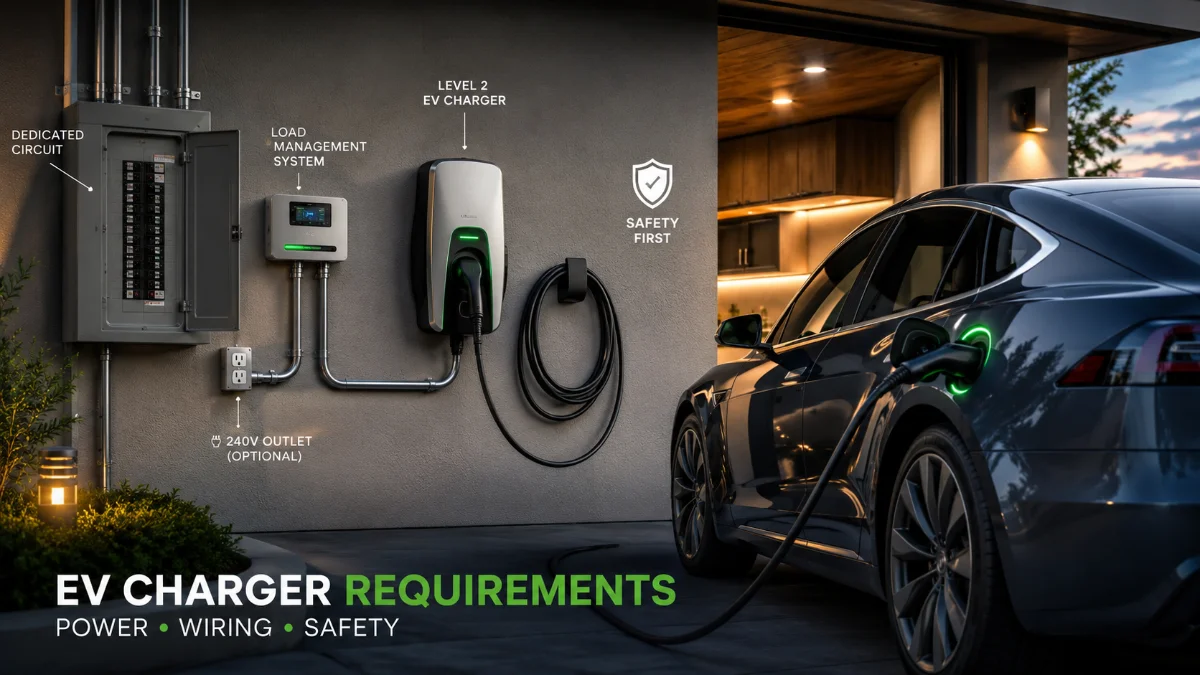

Before starting EV charger installation, homeowners need to answer one question: can the property safely supply the charging load they actually need? That requires more than checking whether the electrical panel has an empty breaker position.
The vehicle, EVSE, branch circuit, electrical panel, service capacity, wiring route, charging location, and applicable local requirements all need to fit together. For U.S. homes, Level 1 generally uses a suitable 120V connection, while residential Level 2 commonly uses 240V service. DOE recommends professional assessment and compliance with applicable electrical codes and local requirements.
The Five-Part Electrical System You Need to Match
A home charging setup works as a system.
| Part | Key question |
| Vehicle | How much AC power can it accept? |
| EVSE | How much power can the equipment deliver? |
| Circuit | Can the breaker and conductors support the continuous load? |
| Panel/service | Does the home have sufficient calculated capacity? |
| Location | Can the equipment be installed safely and conveniently? |
A high-output EVSE cannot force a lower-rated vehicle to charge faster. Similarly, a powerful EVSE does not solve insufficient electrical-service capacity.
Level 1 vs. Level 2: Which Electrical Setup Do You Need?
The correct charging level depends on how much energy your vehicle needs and how long it is parked.
DOE currently estimates approximately 2-5 miles of range per hour for Level 1 and 10-30 miles per hour for Level 2, with actual performance varying by vehicle and conditions.
Level 1 electrical requirements
Level 1 can be suitable when:
- Daily driving is relatively low.
- The vehicle remains parked overnight.
- You drive a plug-in hybrid.
- A suitable 120V circuit is available.
- You do not need rapid energy recovery.
Level 1’s lower power can also mean a simpler electrical setup than a new Level 2 circuit.
Level 2 electrical requirements
Level 2 is generally the more useful option when a battery-electric vehicle needs regular overnight charging.
The installation usually involves a dedicated circuit and a more substantial electrical assessment.
The correct output depends on:
- Vehicle AC charging limit
- Daily energy consumption
- Parking duration
- Existing service capacity
- Other household loads
- Number of EVs
- Future plans
DC fast charging is not simply “Level 3 at home”
DC fast charging uses a different architecture and much higher power than normal residential AC charging.
It is primarily associated with public, fleet, and commercial installations, where electrical service, utility coordination, equipment, site construction, and operating requirements can support the higher load.
Electrical Capacity: The Most Important Pre-Installation Check
The home’s electrical service must be evaluated before choosing a final charging configuration.
A load assessment considers the home’s existing electrical demand and the additional EV charging load.
Large existing loads may include:
- Electric heating
- Central air conditioning
- Water heaters
- Electric cooking
- Clothes dryers
- Pools
- Spas
- Workshops
- Battery systems
- Solar equipment
- Existing EV charging
Why an empty breaker slot proves very little
An empty position in the panel means there may be physical space for another breaker. It does not prove that the service has sufficient calculated capacity.
This distinction prevents one of the most common planning mistakes in home charging.
A panel can have space but insufficient capacity.
A panel can also appear full while the property has other compliant options available.
Understanding Continuous-Load Requirements
EV charging can continue for several hours, so applicable NEC principles treat EV charging as a continuous load.
For illustration:
40A continuous charging current × 1.25 = 50A circuit capacity
This does not mean that every 40-amp EVSE must simply be connected to a 50-amp breaker without further analysis.
The electrician must consider:
- EVSE configuration
- Circuit rating
- Conductors
- Terminations
- Installation environment
- Applicable code
- Manufacturer instructions
NFPA documentation concerning NEC Article 625 addresses EV charging as a continuous load and provides requirements for circuit sizing.
EV Charger Wiring Requirements Are Site-Specific
There is no universal answer to “What wire size does an EV charger need?”
The conductor selection can depend on:
- Charging current
- Circuit rating
- Copper or aluminum
- Conductor insulation
- Installation temperature
- Conduit fill
- Distance
- Voltage-drop considerations
- Indoor or outdoor installation
- Underground routing
- Terminal ratings
- Local amendments
- Manufacturer instructions
This is why a generic online wiring chart should not replace a site-specific electrical design.
Panel Upgrade vs. Service Upgrade
These terms are often confused.
A panel upgrade or replacement changes the equipment that distributes electricity within the property.
A service upgrade can involve increasing the capacity of the home’s electrical supply and may require additional equipment and utility coordination.
They are not interchangeable.
A property might need:
- Neither
- A panel change
- A subpanel
- Load management
- A service upgrade
- Some combination of these
The load assessment should determine the appropriate path.
How the Wiring Route Changes the Installation
A charger beside a nearby panel on an unfinished garage wall is a very different project from one located 70 feet away through finished areas or in a detached garage.
Potential routing methods include:
- Exposed conduit
- Interior wall routing
- Ceiling spaces
- Attics
- Crawlspaces
- Basements
- Exterior conduit
- Underground conduit
Each route can change labor, material, access, and restoration requirements.
Detached garages
A detached garage may require underground wiring and additional planning.
Before excavation, discuss:
- Conduit sizing
- Future EV capacity
- Subpanel requirements
- Communications needs
- Additional charging ports
- Restoration
Future-proofing can be worthwhile when the ground is already open, but it should be based on a realistic plan rather than adding unnecessary infrastructure.
Outdoor charging
Outdoor equipment must be suitable for outdoor conditions and installed according to the manufacturer’s instructions.
Consider:
- Water exposure
- Drainage
- Weather
- Sun
- Physical impact
- Vehicle movement
- Cable storage
DOE recognizes outdoor home charging as a normal installation scenario when appropriate equipment and installation practices are used.
Hardwired vs. Plug-In Requirements
A hardwired EVSE connects directly to the electrical circuit. A plug-in model uses a suitable receptacle.
The choice depends on the equipment and installation.
Hardwired installation
Potential advantages include:
- Permanent connection
- No dependence on a frequently used receptacle
- Equipment configurations designed for higher charging output
Plug-in installation
Potential advantages include:
- Portability
- Easier equipment replacement
- Flexibility when a suitable receptacle is already present
An existing 240V outlet should be inspected before use. The plug fitting into the receptacle does not prove that the entire circuit is suitable for sustained EV charging.
Smart Charging and Load Management
Modern charging equipment can sometimes solve an electrical-capacity problem without simply adding more service capacity.
Smart EVSE may offer:
- Scheduled charging
- Remote control
- Energy monitoring
- Time-of-use charging
- Load management
- Multi-EV power sharing
How load management works
Imagine a home with an EV, electric water heater, air conditioning, and electric range.
When several major loads operate simultaneously, the charging system may reduce EV charging power rather than allowing total demand to exceed its planned limits.
This can be particularly useful when:
- The existing service has limited spare capacity.
- Two EVs share the home.
- A service upgrade would be expensive.
- The homeowner plans solar or battery storage.
Load management does not make an undersized circuit safe. The underlying electrical system still has to be correctly designed.
Planning for Two EVs
Two EVs do not necessarily require two independent circuits operating at maximum output simultaneously.
A managed system can distribute available charging power between vehicles.
For example, one vehicle could receive higher charging power while the other receives reduced power. When the first vehicle finishes, available capacity can shift to the second.
This approach makes sense when the vehicles are normally parked for long periods.
Permits and Local Electrical Rules
There is no single nationwide residential permit process.
The local authority having jurisdiction determines the applicable permitting and inspection requirements. DOE states that EV charging installations must comply with applicable state and local codes and regulations.
Before work begins, ask:
- Is an electrical permit required?
- Who obtains it?
- Is an inspection required?
- Who schedules the inspection?
- Are there local utility requirements?
- Does the property have HOA or multifamily restrictions?
Do not assume that a rule found for one city or state applies everywhere.
Equipment Certification and Safety
Equipment selection is another important requirement.
UL Solutions identifies ANSI/UL 2594 for electric vehicle supply equipment and ANSI/UL 2202 for DC charging equipment.
Homeowners should look for equipment appropriate for the intended installation and follow the manufacturer’s instructions.
A sound installation should also account for:
- Grounding
- Required protective devices
- Correct circuit configuration
- Environmental rating
- Physical protection
- Cable management
- Permit and inspection requirements
Avoid damaged outlets, improvised adapters, extension cords used as permanent charging solutions, or unknown circuits.
Read more: EV Charger Installation Requirements: Electrical Capacity, Wiring, Circuits, and Safety
A Better Pre-Installation Checklist
Before purchasing or installing the equipment, work through this sequence:
Vehicle
Confirm the vehicle’s maximum AC charging capability and connector.
Charging need
Estimate typical daily mileage and overnight parking time.
Electrical service
Have the existing load and available capacity assessed.
EVSE
Select equipment that fits both the vehicle and electrical system.
Circuit
Determine the appropriate breaker, conductors, protection, and connection method.
Location
Confirm cable reach, weather exposure, physical protection, and parking alignment.
Permits
Verify local requirements before work begins.
Future needs
Consider a second EV, solar, storage, or a future charger location.
This order is more reliable than buying a high-output EVSE first and asking the electrician to make it work afterward.
Frequently Asked Questions
What are the main EV charger installation requirements?
The major requirements are a compatible EVSE, suitable electrical capacity, an appropriately designed circuit, properly selected conductors and protection, a suitable installation location, and compliance with applicable electrical and permitting requirements.
Does a Level 2 charger need a dedicated circuit?
Level 2 EVSE generally uses a dedicated circuit. The exact design depends on the equipment and applicable requirements, but sharing a high continuous charging load with unrelated appliances should not be assumed to be acceptable.
Why is EV charging considered a continuous load?
Because an EV may draw substantial current for several hours, electrical design must account for sustained operation rather than treating charging like a brief appliance load.
Can a 100-amp electrical service support Level 2 charging?
Sometimes. The main service rating alone does not answer the question. A load calculation must consider existing household demand and the proposed charging load.
Is there one correct wire size for an EV charger?
No. Wire selection depends on the circuit, current, conductor material, installation conditions, distance, code, and equipment instructions.
Does every Level 2 charger require a panel upgrade?
No. Many homes can support Level 2 charging without replacing the panel. Others may need load management, a subpanel, panel work, or a service upgrade.
Can I use a dryer circuit for EV charging?
Do not assume that an existing dryer circuit can simply be repurposed. The circuit, outlet, wiring, breaker, load calculation, and local requirements need to be evaluated.
Can a Level 2 charger be installed in a detached garage?
Yes, but the project may require underground conduit, trenching, additional electrical equipment, and a longer wiring route.
Are permits required for EV charger installation?
Permit requirements vary by jurisdiction. Many electrical installations require permitting and inspection, so confirm the local process before beginning work.
Can smart charging prevent a panel upgrade?
It can sometimes reduce or control charging demand enough to avoid a larger upgrade, but it is not appropriate for every property. The electrical system and load-management equipment must be designed together.
Final Verdict
The most reliable EV charger installation is one designed around the complete electrical system rather than the charger alone. Evaluate the vehicle, charging need, service capacity, wiring route, installation environment, and local requirements before choosing the final equipment. That sequence reduces the risk of unnecessary upgrades and gives you a charging system that works with the home rather than against it.