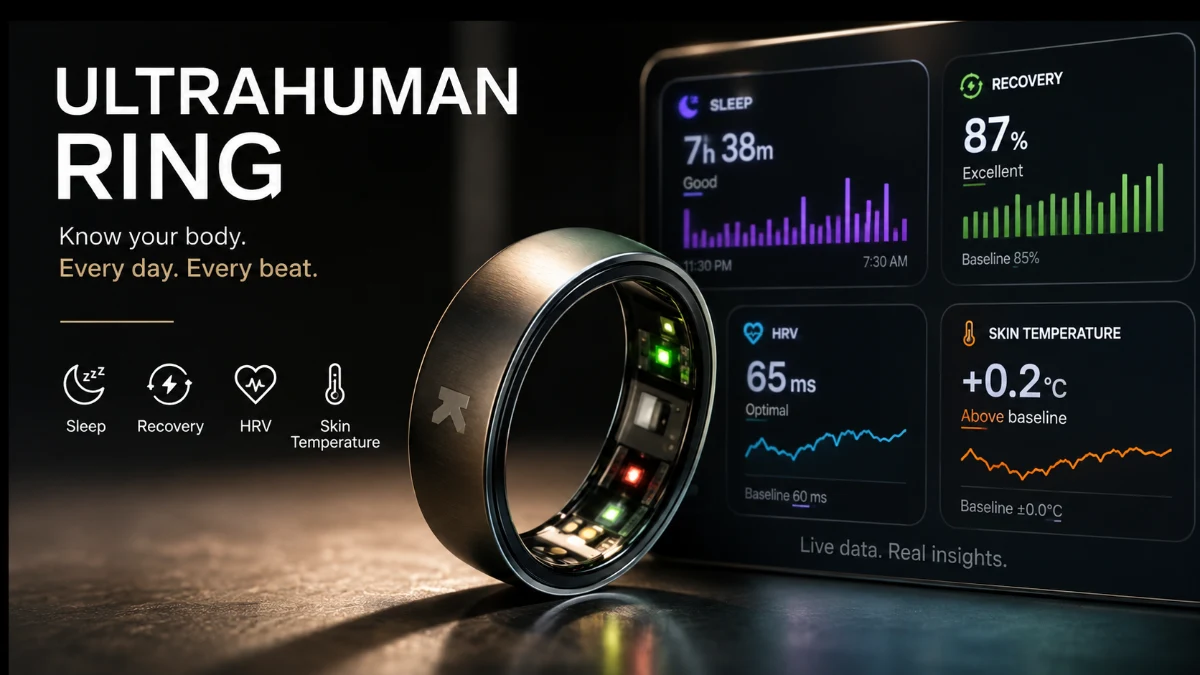

A smart ring can give you a surprising amount of health data from a device that weighs only a few grams. But the useful question is not simply what the Ultrahuman Ring can display. It is how those numbers are produced, which sensors contribute to them, and where estimation begins.
The Ultrahuman Ring combines optical heart-rate sensing, temperature measurement, motion detection, and software algorithms to turn raw signals into metrics such as sleep, HRV, recovery, and activity insights. Ring PRO adds a redesigned PPG system, on-chip machine learning, and substantially more onboard storage, while Ring AIR uses the earlier hardware architecture.
That distinction matters because a score shown in an app is not a direct measurement of something like “recovery.” It is an interpretation built from several physiological signals.
What the Ultrahuman Ring Is Actually Measuring
The easiest way to understand the Ultrahuman Ring is to separate its hardware from its software.
The hardware collects signals. The software processes those signals and turns them into estimates, trends, scores, and recommendations. Heart rate comes from optical sensing. Temperature comes from a dedicated temperature sensor. Movement comes from the inertial measurement unit. Sleep and recovery scores are then calculated from combinations of those signals and other contextual information.
That means the ring does not have a single “sleep sensor” or “recovery sensor.” Different measurements contribute to the final interpretation.
Ring AIR uses PPG, temperature sensing, and a 6-axis motion sensor. Ring PRO retains those core sensing categories but adds a redesigned PPG system, a dual-core processor with on-chip machine learning, and up to 250 days of on-ring storage
The Three Core Sensors
Most of the important overnight information starts with three sensor systems: photoplethysmography, temperature sensing, and motion detection.
PPG: How the Ring Reads Heart Activity
Photoplethysmography, or PPG, uses light to detect changes in blood volume beneath the skin. The ring’s optical system can then derive pulse-related measurements from those changes.
That is the foundation for heart-rate measurements and contributes to HRV-related analysis. Ring PRO uses a redesigned PPG architecture that Ultrahuman says improves signal quality during sleep and recovery. It also moves more processing onto the ring itself through on-chip machine learning.
This does not mean that every number produced by PPG is a direct clinical measurement. Optical wearables can be affected by movement, fit, skin contact, circulation, and other individual factors. The right way to interpret the data is as continuous physiological monitoring rather than a laboratory instrument attached to your finger.
Temperature: Looking for Change, Not Just a Number
The ring also uses a non-contact temperature sensor. Its value is less about telling you that your skin is exactly a particular temperature and more about identifying changes relative to your normal pattern.
That distinction is important.
A wearable can be useful when it notices that your overnight temperature trend is different from your usual baseline. Temperature-related trends can also contribute to features such as cycle and ovulation insights.
Ultrahuman’s platform uses temperature alongside other physiological signals rather than treating a single temperature reading as a standalone diagnosis.
Motion: The Context Around the Other Signals
The 6-axis motion sensor detects movement and orientation changes. During the day, that information contributes to activity tracking. During sleep, movement provides another signal that helps the software distinguish periods of stillness and restlessness.
Motion alone cannot tell a wearable exactly what sleep stage a person is in. The important point is that the Ultrahuman Ring combines movement with physiological signals rather than relying on movement as the entire picture.
That is why a sleep score should not be interpreted as a direct sensor reading. It is an algorithmic estimate built from multiple inputs.
How Sleep Tracking Works
Sleep tracking is where the different pieces of the system come together.
The Ultrahuman Ring collects overnight heart-rate-related signals, HRV information, temperature trends, and movement data. The software then uses these inputs to construct sleep summaries and scores.
Ultrahuman describes its Sleep Index as being based on more than ten contributing metrics. Those include factors related to sleep duration, timing, restfulness, and physiological measurements.
The important takeaway is that the final sleep score is not equivalent to “hours asleep.”
Two people can both sleep seven hours and receive different assessments because their sleep timing, physiological patterns, movement, and other signals may differ.
Sleep Duration Is Only One Part of the Picture
It is tempting to treat sleep duration as the most important number on the dashboard. It is certainly important, but it does not tell the entire story.
For example, someone might spend eight hours in bed but have frequent periods of wakefulness. Another person might sleep for a similar duration but maintain a more consistent schedule and show different overnight physiological patterns.
Ultrahuman’s own large-scale analyses illustrate why trends can be more informative than a single night’s score. In one 2026 analysis involving 229,837 ring members, the company reported that several overnight recovery markers were strongest among people whose habitual sleep fell within the 7–9-hour range.
That is useful population-level evidence, but it should not be interpreted as proof that the ring can determine the ideal sleep duration for every individual.
Sleep Stages Are Estimates
The Ultrahuman Ring presents information about light, deep, and REM sleep. These stages are not directly observed in the same way they are during a clinical polysomnography study.
A sleep laboratory can use multiple signals, including brain activity, eye movements, and muscle activity, to classify sleep stages. A consumer ring does not have that full clinical sensor array.
Instead, the ring estimates sleep stages using available signals such as movement and cardiovascular patterns.
That makes one-night stage totals less useful than longer-term patterns. If the app says you had 1 hour 12 minutes of deep sleep one night and 58 minutes the next, that difference should not automatically be treated as a meaningful physiological change.
The more useful question is whether your sleep pattern is consistently changing over weeks.
HRV: What the Number Means
Heart-rate variability is one of the most discussed metrics in wearable health tracking.
HRV describes variation in the timing between successive heartbeats. It is not simply “heart rate with more decimals.” The metric is commonly used as one indicator of autonomic nervous system activity, although interpretation depends heavily on context.
The Ultrahuman Ring incorporates HRV into its recovery system and monitors physiological signals throughout the day and night. Ultrahuman specifically emphasizes continuous monitoring rather than relying only on isolated readings.
A higher HRV is not automatically better in every situation, and a lower number is not automatically a warning sign.
Your own baseline matters.
A meaningful change is often easier to identify when the measurement moves substantially away from your normal pattern and does so alongside other changes such as poor sleep, elevated resting heart rate, unusual fatigue, illness, or increased training stress.
Dynamic Recovery Is an Interpretation Layer
Dynamic Recovery is one of the clearest examples of the difference between raw sensor data and an app-generated score.
The Ultrahuman Ring does not contain a sensor that directly measures “recovery.” Instead, the platform combines several signals to produce a recovery assessment.
Ultrahuman describes Dynamic Recovery as incorporating factors including sleep quality, stress rhythm, skin temperature, and HRV.
Think of it as a dashboard interpretation rather than a medical measurement.
A lower score can be useful as a reason to look more closely at your sleep, training load, or other circumstances. It should not automatically be interpreted as proof that your body is unable to exercise.
The same principle applies to a high score. Feeling unusually tired despite a favorable wearable score is still meaningful. Your subjective experience is another piece of information.
What Ultrahuman’s Large Datasets Add
One interesting development in 2026 is the amount of population-scale analysis Ultrahuman has begun publishing from its ring data.
For example, one company analysis examined 103,490 long-term ring wearers with at least 180 valid sleep nights and reported a relationship between bedtime regularity, overnight resting heart rate, and HRV. Another analyzed 229,837 members to examine habitual sleep duration and overnight recovery markers.
These datasets are valuable because they move beyond the tiny samples often seen in wearable validation studies.
But there is an important caveat: these are observational analyses of Ultrahuman users, not randomized clinical trials. They can reveal associations in a large real-world population, but they cannot establish that changing one behavior will necessarily cause a particular physiological outcome.
That distinction should remain clear whenever these studies are discussed.
PowerPlugs Add Another Layer
PowerPlugs are modular features within the Ultrahuman ecosystem. They extend the basic wearable experience into narrower use cases rather than changing what the ring’s physical sensors are capable of measuring.
Ultrahuman says PowerPlugs and Jade are available to users globally. Some PowerPlugs can be separately priced, so they should not automatically be described as universally included at no additional cost.
Examples include cardiovascular, caffeine, respiratory, cycle-related, and other specialized insights.
AFib Detection Requires Careful Interpretation
AFib detection is one of the features that needs particularly careful wording.
Ultrahuman markets AFib detection as a smart-ring capability, but a wearable flag is not equivalent to a physician diagnosing atrial fibrillation through a clinical evaluation.
An irregular rhythm notification can be a reason to seek appropriate medical advice. It should not be treated as confirmation of a cardiac condition.
The same principle applies to other health-oriented PowerPlugs. A software feature can be useful without being a diagnostic test.
Cycle and Ovulation Insights
Temperature and other physiological trends can be useful for understanding menstrual-cycle patterns.
Ultrahuman has promoted Cycle & Ovulation Pro as a highly accurate ovulation-tracking feature, but the company’s claims about accuracy should be distinguished from independent clinical validation. The safest interpretation is that the feature provides algorithmic cycle and ovulation insights rather than serving as a standalone medical or contraceptive device.
That distinction becomes particularly important when a wearable is used for decisions with medical or reproductive consequences.
Migraine Insights and FDA-Authorized Technology
The migraine feature is another example of why product claims need context.
Ultrahuman partnered with Click Therapeutics to develop its Migraine PowerPlug using technology related to Click’s FDA-authorized digital therapeutic work. Click’s CT-132 received FDA marketing authorization in 2025 for the preventive treatment of episodic migraine in adults.
That authorization belongs to the specific Click therapeutic, not automatically to the Ultrahuman Ring or its migraine feature.
This is an important distinction whenever health technology companies reference regulatory history connected to partner technologies.
What Jade Actually Does
Jade is the most ambitious software development in Ultrahuman’s current ecosystem.
Ultrahuman introduced Jade alongside Ring PRO in February 2026 and describes it as a real-time biointelligence AI. The system is designed to interpret information across the company’s ecosystem, including Ring data, Blood Vision, Ultrahuman Home, and M1 CGM information. Ultrahuman says Jade is available as a platform upgrade to users globally rather than being exclusive to Ring PRO.
That last point matters.
Buying Ring PRO does not automatically mean you are buying an AI feature that AIR owners cannot access. The hardware differences between the rings remain important, but Jade itself is positioned as an ecosystem-level software layer.
The broader idea is to move from passive reporting toward interpretation and action. Instead of simply showing a higher stress marker, an AI layer could use multiple data streams to suggest an appropriate response.
Whether those recommendations consistently improve outcomes is a separate question. The technology is newer than the underlying wearable metrics, so it is better viewed as an evolving software capability than as a clinically established decision-maker.
Why Ring PRO Can Store So Much Data
Ring PRO’s storage system is one of its less visible but technically significant upgrades.
Ultrahuman lists up to 250 days of on-ring data storage and up to one year of storage through the PRO Charger. The ring also uses on-chip machine learning and BLE 5.3.
That is particularly useful when the ring is away from your phone.
For a typical user, you may never notice the storage limit. But frequent travelers, people who spend time outdoors, or anyone who does not sync a wearable regularly can benefit from having a larger buffer.
It also changes the engineering philosophy of the device. The ring is not designed merely as a sensor that immediately forwards everything to a smartphone. More processing and data retention can happen closer to the device itself.
Why Ring PRO Lasts So Much Longer
Ring AIR is rated for roughly 4–6 days of battery life. Ring PRO is rated for up to 15 days in its longer-running mode, with Turbo Mode around 12 days, according to Ultrahuman’s current product specifications. The PRO Charger can extend overall battery availability to up to 45 days.
The improvement is not simply about putting a much larger battery inside the ring.
Ring PRO uses a redesigned sensing system, a dual-core processor, on-chip machine learning, and configurable operating modes. These hardware and software changes allow Ultrahuman to balance processing and sampling demands against power consumption.
The result is especially relevant to sleep tracking. If the ring needs to be removed less frequently for charging, there are fewer opportunities to create gaps in an otherwise continuous dataset.
What the Ring Cannot Know From Its Sensors Alone
There is a natural temptation to treat a smart ring as if it has direct access to everything happening inside your body.
It does not.
A ring can observe signals. Algorithms can interpret those signals. Neither step gives the device unlimited knowledge about your health.
For example, a change in overnight HRV could be associated with training stress, poor sleep, illness, alcohol, psychological stress, or ordinary variation. The number itself does not tell you which explanation is correct.
Similarly, a temperature change does not identify its cause by itself.
This is why longitudinal trends are generally more useful than isolated readings. The Ultrahuman Ring becomes more informative when you compare your current data with your own baseline and look for patterns across multiple nights.
The Biggest Sources of Error
Wearable measurements are not perfectly stable.
Fit is one obvious factor. A ring that rotates significantly or does not maintain consistent sensor contact can make optical measurements less reliable.
Movement is another. Even during sleep, people change position, move their hands, and temporarily disturb sensor contact.
Physiology also varies. Circulation, skin characteristics, temperature, and individual differences can influence optical and temperature measurements.
Finally, algorithms introduce another layer of uncertainty. Sleep stages, recovery scores, and similar outputs are estimates generated from available signals. A more sophisticated algorithm does not turn an estimate into a direct observation.
For that reason, the best way to use the Ultrahuman Ring is as a trend-monitoring system rather than a source of absolute truth.
What the Numbers Are Good For
The strongest use case is pattern recognition.
If your sleep duration falls for several nights, resting heart rate rises, HRV moves away from its usual range, and your recovery score falls at the same time, the combined pattern is more informative than any one number.
Likewise, if your sleep improves while your recovery markers become more favorable over several weeks, that gives you a useful basis for evaluating whether a change in routine is associated with a different physiological pattern.
Ultrahuman’s 2026 population analyses demonstrate this kind of longitudinal approach. Its large cohorts have been used to examine relationships involving sleep timing, sleep duration, resting heart rate, and HRV.
The value is therefore less about asking, “What does my ring say tonight?” and more about asking, “What keeps changing in the same direction over time?”
Where the Evidence Is Strongest – and Where It Is Not
There is useful evidence behind several aspects of the Ultrahuman Ring, but the evidence quality is not identical across every feature.
Hardware specifications such as battery life, sensors, storage, and dimensions are straightforward to verify from the manufacturer’s current documentation.
Large observational datasets can provide useful information about associations between wearable-derived metrics and behavior.
Smaller validation studies can help determine whether measurements agree with reference devices under particular conditions.
But none of those categories should automatically be treated as clinical proof for every feature in the app.
That is particularly important when reading marketing language around “accuracy,” “clinical-grade” performance, or medical terminology. A feature can be technologically impressive and still require additional independent validation before its output should be treated as medically authoritative.
A Better Way to Read Your Ultrahuman Data
Do not chase every fluctuation.
Instead, establish your normal pattern first. Wear the ring consistently, give the algorithms enough data to build context, and pay attention to changes that persist.
Look at several measurements together:
- Sleep duration and timing
- Resting heart rate
- HRV
- Temperature trends
- Movement
- Recovery scores
- Your own subjective energy and fatigue
Then ask what changed in your real life.
A late night, hard training session, long flight, illness, unusual stress, or change in routine can all provide context that the ring cannot independently determine.
That approach turns wearable data from a scoreboard into a feedback system.
Read more: How the Ultrahuman Ring Measures Sleep, Recovery, and Health
The Bottom Line
The Ultrahuman Ring is best understood as a layered measurement system rather than a tiny medical device.
PPG provides cardiovascular signals. Temperature sensing adds another physiological trend. Motion provides behavioral context. Software combines these inputs into sleep, recovery, and activity estimates. PowerPlugs extend the platform into narrower use cases, while Jade is pushing Ultrahuman toward a broader AI interpretation layer.
Ring PRO represents the company’s biggest hardware step forward, particularly with its redesigned PPG system, on-device processing, 250-day storage capacity, and much longer battery life.
But the most important lesson is simpler: the number on the screen is an estimate, not the underlying reality itself.
Use the data to identify patterns, compare changes with your own baseline, and generate better questions about your habits. Do not use a wearable score as a substitute for professional medical assessment when something genuinely concerns you.
Frequently Asked Questions
What sensors does the Ultrahuman Ring use?
The Ultrahuman Ring uses PPG-based optical sensing, a temperature sensor, and a 6-axis motion sensor. Ring PRO adds a redesigned PPG system and on-chip processing.
How does the Ultrahuman Ring measure sleep?
It combines movement and physiological signals such as heart-rate-related data and temperature trends to estimate sleep duration, sleep stages, and other sleep metrics. Sleep-stage results are algorithmic estimates rather than direct measurements from a clinical sleep laboratory.
Does the Ultrahuman Ring measure HRV?
Yes. HRV is one of the physiological signals used by the Ultrahuman Ring platform, including its recovery analysis. Ultrahuman emphasizes continuous monitoring across the day rather than relying solely on occasional readings.
What is Dynamic Recovery?
Dynamic Recovery is an Ultrahuman composite score that uses multiple signals, including sleep quality, stress rhythm, temperature trends, and HRV, to provide an estimate of recovery. It is an interpretation of several measurements rather than a direct physiological measurement.
Can the Ultrahuman Ring diagnose health conditions?
No. Wearable features should not be treated as substitutes for clinical diagnosis. Even when a feature is designed to identify patterns associated with a health condition, confirmation may require appropriate medical testing.
What is Jade in the Ultrahuman app?
Jade is Ultrahuman’s real-time biointelligence AI layer. It is designed to interpret information across the company’s ecosystem, including Ring, Blood Vision, Home, and M1 CGM data. Ultrahuman says Jade is available as a platform upgrade to users globally.
Does Ring PRO track health differently from Ring AIR?
The two models share the same broad categories of measurements, but Ring PRO has a redesigned PPG system, dual-core processing with on-chip machine learning, and much greater onboard storage.
How long does Ring PRO store health data?
Ultrahuman states that Ring PRO can store up to 250 days of data on the ring, while the PRO Charger can store up to one year of ring data.
Is Ultrahuman’s migraine technology FDA-authorized?
Click Therapeutics’ CT-132, the prescription digital therapeutic underlying the partnership referenced by Ultrahuman, received FDA marketing authorization for the preventive treatment of episodic migraine. That authorization applies to CT-132, not automatically to the Ultrahuman Ring or its Migraine PowerPlug.
Should you trust every number shown by the Ultrahuman Ring?
No wearable number should be treated as infallible. The most useful approach is to look at sustained changes across several metrics and compare them with your own baseline and real-world circumstances. A persistent or concerning health change should be evaluated through appropriate professional care rather than a wearable score alone.