
Choosing the right vending machine starts with the products and customers, not the cabinet itself. A compact snack machine may be ideal for an office, while a refrigerated unit may be better for fresh meals. A smart cooler can make sense when customers need open access to multiple products, and a connected beverage machine may be the simplest solution when the goal is fast, repeat purchases.
There is no single best vending machine for every location.
The right choice depends on four things: what you want to sell, who will buy it, where the equipment will operate, and how much operational complexity you are prepared to manage.
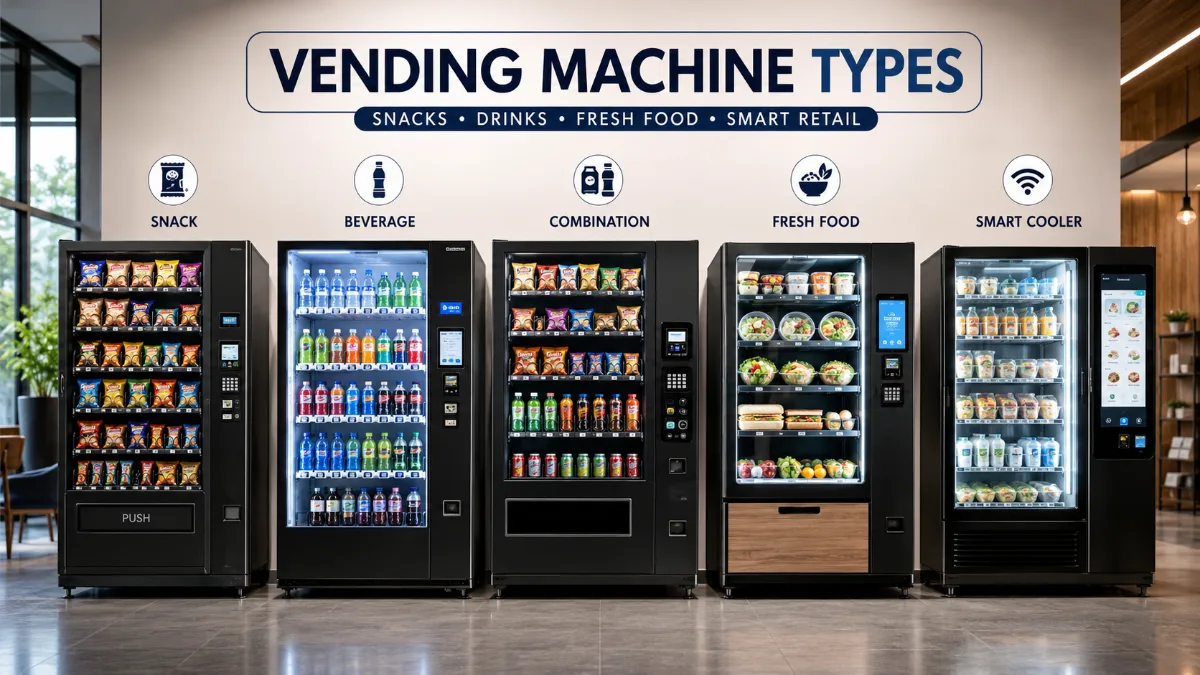
The Main Types of Vending Machines
A vending machine can be classified by the products it sells, the way it dispenses them or the technology used to operate it.
For most buyers, product format is the most useful starting point.
| Type | Best suited to | Main consideration |
| Snack machine | Packaged snacks | Product variety and shelf space |
| Beverage machine | Bottles and cans | Capacity and refrigeration |
| Combination machine | Snacks + drinks | Efficient use of floor space |
| Coffee machine | Hot drinks | Water, cleaning and servicing |
| Fresh-food machine | Meals and chilled products | Temperature and shelf life |
| Frozen machine | Frozen products | Reliable refrigeration |
| Smart cooler | Grab-and-go products | Security and computer vision |
| Micro market | Broad assortment | More space and self-checkout |
Snack Vending Machines
The classic snack vending machine is designed around packaged products that can remain stable at room temperature.
Typical products include:
- Chips
- Cookies
- Candy
- Nuts
- Crackers
- Protein bars
- Packaged snacks
Its biggest advantage is simplicity.
Products generally do not require refrigeration, and the operator can dedicate individual selections to different products.
The main challenge is choosing a mix that matches local demand.
An office with health-conscious employees may respond differently to a snack assortment than a manufacturing facility with overnight shifts.
Beverage Vending Machines
A beverage vending machine is optimized for bottles, cans, or other packaged drinks.
Common products include:
- Water
- Soft drinks
- Juice
- Sports drinks
- Energy drinks
- Other packaged beverages
Capacity, refrigeration, and energy consumption become more important here.
A beverage machine also needs to handle heavier products and potentially higher purchase frequency than some snack machines.
Location can strongly influence the mix. A gym, factory, or outdoor recreation facility may have very different beverage demand from an office lobby.
Combination Vending Machines
A combination vending machine puts multiple product categories into one cabinet.
This is useful when floor space is limited, but customers want both drinks and snacks.
The tradeoff is capacity.
A machine divided between categories has fewer selections available for each category than dedicated equipment.
For a smaller location, however, the space efficiency can outweigh that limitation.
Fresh-Food Vending Machines
Fresh-food equipment is fundamentally different from conventional snack vending because inventory condition matters as much as sales volume.
Products may include:
- Sandwiches
- Salads
- Prepared meals
- Fruit
- Chilled snacks
- Other perishable foods
Temperature management becomes critical.
The operator must monitor product shelf life, refrigeration performance, and replenishment schedules.
In the United States, FDA calorie-labeling requirements apply to covered operators owning or operating 20 or more vending machines, with specific rules and exemptions.
Fresh-food vending can create a more valuable assortment, but it also introduces more operational risk than shelf-stable snacks.
Coffee and Hot-Drink Machines
A coffee vending machine can prepare or dispense hot beverages rather than simply releasing a packaged item.
These systems can require:
- Water supply or refill
- Ingredient management
- Cleaning
- Waste handling
- Heating components
- More frequent servicing
They can be attractive in workplaces, hospitals, hotels, and other environments where customers want hot drinks without a staffed café.
The business case depends on whether the location has enough demand to justify the additional maintenance.
Frozen Vending Machines
Frozen vending equipment can serve products that require consistent low temperatures.
The key consideration is refrigeration reliability.
A frozen vending machine should therefore be evaluated not only for capacity and appearance but also for:
- Temperature control
- Energy requirements
- Service support
- Product loading process
- Alarm systems
- Recovery performance after power interruptions
The equipment can work well in suitable locations but is more operationally demanding than a basic snack machine.
Smart Coolers: The New Alternative to Conventional Vending
A smart cooler changes how customers interact with products.
Instead of selecting one item through a slot, the customer may authenticate payment, open a secured cooler, take products directly from the shelves, and have the system determine what was removed.
365 Retail Markets currently markets PicoCooler Vision using AI-powered product recognition for this type of unattended retail.
This format can support:
- Fresh food
- Larger packages
- Mixed assortments
- Multiple-item purchases
- Refrigerated products
- Grab-and-go retail
The technology is more sophisticated because the system must determine what happened inside the cooler.
Micro Markets vs. Vending Machines
A micro market is not simply a larger vending machine.
It is an unattended retail environment where customers can browse products directly and use self-checkout technology.
Micro markets can offer significantly more assortment, but they usually need more physical space and stronger security.
NAMA identifies micro markets as a major part of the broader convenience-services industry and describes them as self-service retail environments that combine open product access with automated checkout.
Which format should you choose?
| Situation | Better starting format |
| Small office | Snack or combination machine |
| Beverage-heavy location | Beverage machine |
| Limited floor space | Combination machine |
| Fresh meals | Fresh-food machine or smart cooler |
| High product variety | Micro market |
| Secure grab-and-go | Smart cooler |
| Hot beverages | Coffee machine |
| Large established operation | Combination of formats |
How Payment Technology Changes the Buying Decision
Payment capability is now an important part of choosing a vending machine.
Older equipment may rely heavily on coins or notes. Modern payment systems can support:
- Credit cards
- Debit cards
- Contactless cards
- Mobile wallets
- Other digital payment methods
365 Retail Markets currently offers payment hardware that can be integrated with vending equipment, including systems designed to add card payments to existing machines.
For buyers, the key issue is compatibility.
Before purchasing older equipment, confirm whether the payment system can be upgraded and whether the manufacturer or payment provider supports the machine’s controller.
Connected Vending and Remote Monitoring
A connected vending machine can transmit information about sales and equipment status to management software.
That can help operators answer practical questions:
- Which machine is selling?
- Which products are moving?
- Which location needs replenishment?
- Which machine has an error?
- Which route should be serviced first?
Remote monitoring becomes more valuable as the number of machines increases.
For one unit located nearby, a physical visit may be inexpensive. For dozens of machines spread across a region, unnecessary visits can become a meaningful operating cost.
Should You Buy an AI Vending Machine?
AI should be evaluated by use case rather than by the label.
Computer vision can make sense for open-shelf retail because the system needs to identify products that customers remove directly.
For a conventional spiral vending machine, however, the product is already associated with a specific selection. Advanced visual recognition may provide little additional value.
Demand forecasting can be more broadly useful, but its effectiveness depends on having enough accurate sales information.
The practical decision is:
If a feature does not solve a measurable problem, it may not justify its cost.
New vs. Used Vending Machines
The choice between new and used equipment depends on risk tolerance and technical requirements.
Used equipment
Advantages:
- Lower initial purchase price
- Potentially easier to test a business model
- Access to older, proven designs
Risks:
- Mechanical wear
- Outdated payment hardware
- Limited parts availability
- Higher repair requirements
- Greater energy consumption in some older equipment
New equipment
Advantages:
- Newer components
- Better payment compatibility
- Manufacturer support
- More modern connectivity
- Potentially better energy performance
Risks:
- Higher initial investment
- More technology complexity
- Greater depreciation exposure
For a first-time operator, the best choice depends on the location and financial model rather than a simple “new is better” rule.
What Should You Look for Before Buying?
A buyer should evaluate the entire system.
Product capacity
Make sure the machine can hold enough inventory without making replenishment inefficient.
Payment compatibility
Confirm the equipment supports the payment methods customers are likely to use.
Power requirements
Refrigerated and heated equipment can have very different electrical requirements from basic ambient machines.
Service support
A machine that cannot be repaired quickly can lose sales while it is offline.
Parts availability
Ask how easily motors, controllers, refrigeration components, and payment hardware can be replaced.
Connectivity
If remote management matters, confirm the machine can connect to the required network and software platform.
Location fit
Measure the available floor space, access path, electrical supply, and customer flow before purchasing.
Security and Privacy Matter More With Smart Equipment
Advanced systems can collect considerably more information than a basic vending machine.
Payment systems process transaction information. Connected software can record operational data. Camera-enabled systems may collect images or other information depending on how they are designed.
The University of Waterloo case illustrates why privacy should be evaluated during procurement. Ontario’s privacy commissioner found that intelligent vending machines used cameras and face-detection technology to capture identifiable facial images, and the regulator identified deficiencies in the university’s procurement due diligence.
The regulator later issued a revised report in August 2025 correcting technical details about the software while maintaining the underlying findings.
For buyers, the lesson is simple: understand what a camera or analytics system collects before installing it.
The Best Vending Machine Depends on the Customer
A common purchasing mistake is comparing machines based only on features.
Instead, start with the customer.
| Customer need | Equipment priority |
| Quick packaged snack | Simple snack machine |
| Cold beverage | Refrigerated beverage machine |
| Mixed snack + drink purchase | Combination machine |
| Fresh meal | Fresh-food equipment |
| Coffee break | Hot-drink machine |
| Grab-and-go assortment | Smart cooler |
| Large self-service assortment | Micro market |
The same vending machine can be excellent in one environment and completely wrong in another.
Read More: Vending Machine Types -Find the Right Option for Your Business
A Simple Buying Framework
Before committing to equipment, answer these questions:
- What products will be sold?
- Who is the target customer?
- How many potential buyers are present?
- How long do they remain at the location?
- What alternatives are nearby?
- Does the product require refrigeration?
- What payment methods will customers expect?
- How often will the machine need restocking?
- Who will service it?
- What technology is genuinely necessary?
If the answers are clear, equipment selection becomes much easier.
Frequently Asked Questions
What are the main types of vending machines?
The major categories include snack, beverage, combination, coffee, fresh-food, and frozen machines, along with newer smart coolers and unattended-retail formats.
What is the best vending machine for a small business?
There is no universal best choice. A combination or snack machine may work well for a small location, while a smart cooler can make more sense when the product assortment requires open-shelf access.
Are beverage vending machines profitable?
They can be, but profitability depends on location demand, product margins, pricing, machine capacity, payment costs, and operating expenses.
What is a combination vending machine?
A combination vending machine sells multiple categories, commonly snacks and beverages, from one cabinet. It can be useful where floor space is limited.
Are smart coolers better than vending machines?
Not automatically. Smart coolers offer more flexible product access and can support computer-vision checkout, while conventional machines can be simpler and less expensive for standardized products.
What is a micro market?
A micro market is an unattended retail environment where customers can select products directly from shelves and complete payment through a self-checkout system.
Can an old vending machine accept card payments?
Some older machines can be upgraded with compatible cashless payment hardware, but compatibility depends on the machine’s controller, payment system, and available connectivity.
Should I buy a new or used vending machine?
Used equipment can reduce upfront costs, while new equipment can provide newer payment, connectivity, and service capabilities. The decision should account for total ownership cost rather than purchase price alone.
Do smart vending machines require internet?
Connected equipment needs some form of network connection to transmit remote data. Depending on the system, that may be cellular, Wi-Fi, or another supported connection.
What should I check before buying a vending machine?
Check product capacity, payment compatibility, electrical requirements, service support, parts availability, connectivity, physical dimensions, operating costs, and whether the equipment fits the intended location.
Final Verdict
Choosing a vending machine is ultimately a matching exercise. The best equipment is not the most expensive, the newest, or the one with the longest list of features. It is the system that fits the products, customers, location, and operating model without creating unnecessary complexity.