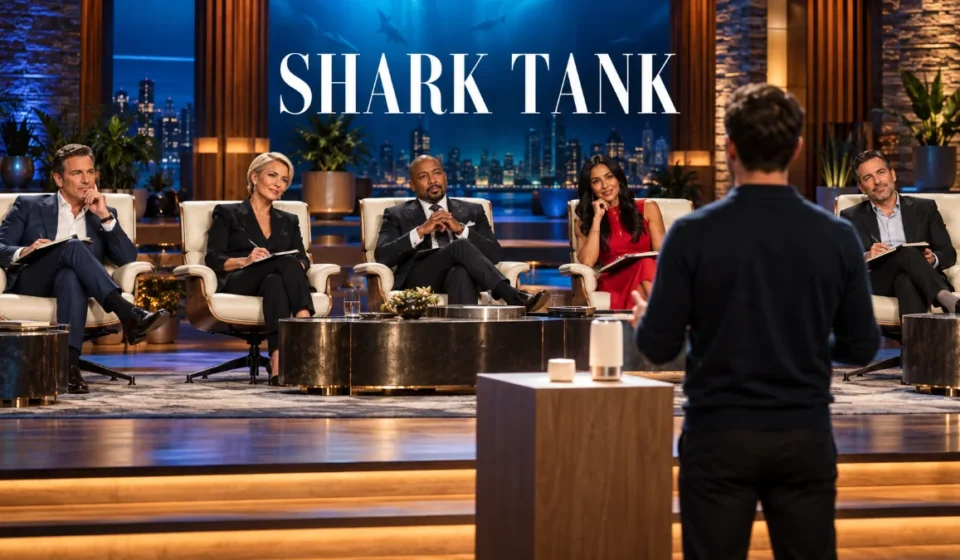

Shark Tank: Shark tank is an American business reality television series that premiered in 2009 on ABC Viewers witness product-pitches, challenges posed to entrepreneurs and negotiations — resulting sometimes in a deal
So really, the U.S. version where to watch who are the investors and how to each speak digit by digit, shout out What it describes is especially critical — just because there’s an offer on TV doesn’t mean you’ve made a million-dollar investment.
Viewing, cast, and casting information checked: October 1, 2026.
| Quick question | Answer |
|---|---|
| What is the show? | Entrepreneurs present businesses to investors and negotiate potential funding. |
| Where can U.S. viewers watch? | Start with ABC’s official episode page or Hulu. |
| Who are the sharks? | The current panel includes eight regular investors, with guests appearing in selected episodes. |
| Does an accepted offer guarantee investment? | No. Further verification and agreements may follow. |
What Is Shark Tank?
The U.S. Show’s Format in Plain English
A founder typically introduces a business, demonstrates its product, and requests a specific investment for a percentage of ownership. The investors then question the company’s sales, costs, competition, and growth plans.
For example a founder might request $100,000 for 10% of a company. An interested investor could accept request more ownership or propose different terms.
There is no single cash prize or overall tournament winner. Each pitch is a separate negotiation. When an investor says they are “out,” they are declining to pursue that business.
Shark Tank vs. Shark Tank India
The American and Indian programs are separate national editions with different investor panels and viewing arrangements.
| Feature | U.S. edition | Indian edition |
| Primary market | United States | India |
| Main language | English | Hindi |
| Official starting point | ABC’s show page | SonyLIV’s show page |
| Investors | U.S. regular panel and guests | Separate India-specific panel |
SonyLIV lists the Indian program as a Hindi-language reality series with five seasons. Searching the edition name alongside an investor or business helps prevent confusing the two programs.Where to Watch Shark Tank in the United States
Read more: Shark Tank
Official Full Episodes and Streaming Options
ABC’s official page provides full-episode listings, clips, business recaps, and links to Hulu. Its current program description identifies Season 18 as the 2026–2027 season.
| Viewing route | What to look for | Access considerations |
| ABC | Listed full episodes, clips, and recaps | Follow the access requirements shown for each episode |
| Hulu | Streaming episodes | Requires an eligible subscription; check the current catalog |
| Local ABC station | Scheduled television broadcast | Reception or access depends on your location and television service |
Check the actual episode listing before subscribing for a particular season. A platform promoting the program does not necessarily offer every historical episode.
Use ABC’s schedule for upcoming broadcasts rather than relying on an old article’s day and time. Streaming catalogs, access rules, and television schedules can change.
How to Find a Particular Episode or Business
If you remember a product but not its episode:
- Search the business name with the program name.
- Look for an official episode listing or business recap.
- Confirm the founder, product, season, and episode.
- Open the matching episode through an official viewing source.
A short clip may show a dramatic exchange while leaving out the opening request or final terms. Watch the full segment when you want to understand the negotiation.
Who Are the Sharks?
The Current U.S. Investor Panel
ABC lists the following regular investors for Season 18. Their backgrounds offer context for their questions, although any individual investment still depends on the business and proposed terms.
| Investor | Business background | Current role |
| Barbara Corcoran | Real estate entrepreneurship | Regular shark |
| Lori Greiner | Invention and consumer-product brand building | Regular shark |
| Robert Herjavec | Cybersecurity and technology | Regular shark |
| Daymond John | Fashion and branding | Regular shark |
| Daniel Lubetzky | Entrepreneurship and investing | Regular shark |
| Kevin O’Leary | Venture investing | Regular shark |
| Kendra Scott | Jewelry and lifestyle branding | Regular shark |
| Rashaun Williams | Venture capital and sports investment | Regular shark |
You can explore their official biographies through
A regular cast listing does not mean all eight investors sit together for every pitch. Check the episode’s lineup when researching a particular negotiation.
Former Sharks and Guest Investors
Older episodes feature investors who are no longer regular participants. Mark Cuban’s farewell episode aired as the Season 16 finale on May 16, 2025.Guest investors join selected episodes. ABC’s Season 18 description names guests including MrBeast, Mindy Kaling, J.J. Watt, and Steven Bartlett. Their guest status differs from membership in the regular panel.When checking a cast claim, ask which season and episode it describes. Historical clips often circulate long after their original broadcast.

How a Pitch Works From Start to Finish
The Business Demonstration and Funding Request
A strong opening makes three things understandable: the customer’s problem, how the product solves it, and why the business needs funding.
Consider a hypothetical founder selling a reusable kitchen container. They demonstrate its seal, describe existing customer orders, and request $100,000 for 10% equity to increase inventory.
The demonstration explains the product. The sales evidence supports demand. The funding plan explains how the investment could help. Those are different claims, and each deserves scrutiny.
The Questions Investors Ask
Investors may explore:
- Sales: Is the number monthly, annual, or lifetime revenue?
- Costs: What does each item cost to manufacture and deliver?
- Demand: Do customers reorder, or purchase only once?
- Competition: Why would someone choose this product?
- Ownership: Who already owns shares?
- Funding: What will the new money pay for?
Revenue is not profit. If a hypothetical product sells for $25 and its cost of goods sold is $10, it generates $15 of gross profit per unit—a 60% gross margin—before advertising, salaries, and other operating expenses.
A business can therefore report impressive sales while still losing money.
Offers, Counteroffers, and Rejection
An investor might request more equity, offer a loan, seek royalty payments, or propose investing alongside another shark. The founder can negotiate or decline.
The possible outcomes are straightforward:
| Outcome | What it means |
| No investor makes an offer | The pitch ends without an investment agreement |
| Founder declines available offers | Proposed terms were not accepted |
| Founder accepts an offer | An on-air agreement is reached, with further steps potentially remaining |
Rejection may reflect valuation, business risk, or investor fit. It does not establish that customers will reject the product.
Understanding Equity, Valuation, Royalties, and Loans
How to Calculate Implied Valuation
For a straightforward investment purchasing newly issued equity:
Implied post-money valuation = investment ÷ ownership fraction
Convert the percentage to a decimal before calculating.
| Hypothetical offer | Investment | Equity | Implied post-money valuation |
| Founder’s request | $100,000 | 10% | $1,000,000 |
| Investor’s counteroffer | $100,000 | 20% | $500,000 |
| Alternative offer | $150,000 | 15% | $1,000,000 |
The first calculation is $100,000 ÷ 0.10 = $1,000,000.
For that simple transaction, subtracting the new investment produces a $900,000 pre-money valuation. “Pre-money” describes the value before funding; “post-money” includes the investment.
The percentage matters as much as the dollar amount: raising more money can also mean selling more ownership. Y Combinator’s explanation of dilution illustrates this relationship. Use an ordinary calculator for the arithmetic. The result expresses the offer’s implied valuation; it does not independently establish the company’s fair value or capture every contractual detail.
How Royalties and Loans Change an Offer
Different structures create different obligations.
| Structure | How the investor may earn a return | What the founder should examine |
| Equity | Ownership-related distributions or a future sale | Percentage, voting rights, and future dilution |
| Royalty | Payments tied to units sold or revenue | Rate, payment basis, duration, and cap |
| Loan | Principal repayment and interest | Repayment schedule, interest, security, and guarantees |
| Combination | More than one return mechanism | Total obligations across all components |
For a hypothetical $1-per-unit royalty, selling 30,000 qualifying units produces $30,000 in royalty payments. Whether those payments stop at a cap depends on the agreement.
A loan generally requires repayment according to its terms. Ordinary equity funding does not carry the same scheduled principal repayment, although actual agreements can contain additional rights or obligations.
Do not apply the simple equity formula to an entire mixed offer without separating its components.
Why the Biggest Cash Offer May Not Be the Best Fit
Compare what the founder receives with everything they give up.
A larger investment might require substantially more ownership. A royalty may preserve equity while reducing the cash retained from each sale. A loan may preserve ownership while creating repayment pressure.
Investor expertise can also matter. Relevant retail relationships, manufacturing knowledge, or distribution experience may be useful—but the founder should understand what support is actually promised.
Ask: What cash enters the business, what ownership leaves, and what payments remain?
Beyond the Handshake: What Viewers Should Verify
An On-Air Agreement vs. a Completed Investment
A televised handshake shows that the parties accepted proposed terms during the pitch. It does not, by itself, document a completed investment.
Further due diligence can include reviewing financial records, testing products, and checking business claims. The American program’s competitor entry already discusses this post-show process and agreements that do not proceed. The practical improvement is to identify which stage the available evidence actually supports. Avoid assuming a universal completion timeline or repeating an old closing-rate estimate as a current statistic.
How to Check a Deal’s Reported Status
Use a clear evidence standard:
| Status | Supporting evidence | Accurate description |
| On-air agreement | Episode or official recap | Accepted an offer during the pitch |
| Reported completed investment | Dated founder or investor confirmation | A party reported that the investment closed |
| Reported noncompletion | Dated statement from a party | A party reported that the deal did not close |
| Unverified | No reliable follow-up located | Completion status could not be confirmed |
Start with the episode, then look for dated statements from the founder or investor. Check whether a later interview describes revised terms rather than the original offer.
No public update does not mean the deal failed. Some investment details remain private.
How to Verify “As Seen on Shark Tank” Product Claims
Before buying a product advertised with a television connection:
- Find its business name in an official episode record.
- Match the founder and product.
- Locate the company’s verified website.
- Check the seller’s identity, return policy, and warranty.
- Distinguish an appearance from an investment or endorsement.
ABC maintains business recaps that can help establish which products appeared.Be especially careful when an advertisement leads to an unfamiliar seller using a similar product name. Television exposure does not establish that every listing is genuine, or that the product suits your needs.

Three Pitches That Teach Different Business Lessons
A Lesson in Product Demonstration
Scrub Daddy founder Aaron Krause appeared in 2012 and secured a partnership with Lori Greiner. In a contemporaneous interview, he described the agreement as $200,000 for 20%. The company’s own history also identifies the presentation and resulting partnership.
The useful lesson is how a physical demonstration makes a product’s function understandable. Viewers can observe what it does instead of relying entirely on promotional language.
When watching, ask whether the demonstration proves a meaningful customer benefit and whether it resembles ordinary use.
A Lesson in Customer Demand and Business Model
Bombas founders David Heath and Randy Goldberg appeared in Season 6 in 2014. Their later interview describes a $200,000 agreement with Daymond John for 17.5% equity and an ongoing mentoring relationship. The company combines consumer apparel with a donation model: its current website explains that purchases support donations of essential clothing. The analytical lesson is to assess both customer value and operating economics. A social mission can differentiate a brand, but viewers should still ask about product quality, acquisition costs, margins, and repeat purchasing.
A Lesson in Success After Leaving Without a Deal
Jamie Siminoff’s Doorbot appeared in 2013 without securing a deal. Amazon’s account explains that the appearance generated sales and that the business later became Ring. Amazon completed its acquisition of Ring in April 2018.This illustrates why an investor’s rejection is not a final verdict on a company. Later product development, funding, and execution can change its trajectory.
It does not prove that every rejected pitch will succeed, or that television exposure alone caused Ring’s subsequent growth.
| Business | Main lesson | Documented outcome |
| Scrub Daddy | Demonstrate the customer benefit | Krause confirmed a partnership with Greiner |
| Bombas | Examine mission alongside business economics | Founders described their investment and mentoring relationship |
| Doorbot/Ring | Separate pitch rejection from later outcomes | No televised deal; subsequent acquisition by Amazon |
How to Find Official Application Information
Locate the Current U.S. Casting Route
Begin with ABC’s official application page. As checked on October 1, 2026, its online application link leads to a Season 19 casting form, separate from the currently listed Season 18 broadcast.Read the full eligibility requirements before submitting. The form includes provisions covering legal presence in the United States, participation authorization, background checks, and applications involving minors.
It also requests a non-confidential business description. Do not assume application submissions are protected as confidential disclosures. ABC states that official casting-team email communication comes from addresses ending in @sharktanktv.com. Verify unexpected messages through the official route.Prepare the Information a Business Pitch Requires
Alongside the application’s current requirements, prepare:
- A concise explanation of the customer problem.
- A working demonstration or clear product description.
- Sales records with consistent reporting periods.
- Product costs and realistic margins.
- Ownership and previous-funding details.
- Your investment request and proposed equity.
- A specific use for the funding.
This is preparation advice, rather than a substitute for the official instructions.
Practice explaining your numbers without exaggeration. If sales increased because of a one-time promotion, explain that context instead of presenting the result as normal ongoing demand.
Frequently Asked Questions
Is Shark Tank a Competition With One Overall Winner?
No. Each entrepreneur negotiates a potential investment separately. Multiple businesses can accept offers in an episode, while others leave without an agreement.
Do the Sharks Invest Their Own Money?
Yes. ABC’s casting information describes investors potentially committing their own money. Compensation for appearing on television is separate from investing in a business.
What Does “I’m Out” Mean?
It means that investor is declining to pursue the pitch. Other investors may remain interested and continue negotiating.
Can an Entrepreneur Turn Down an Offer?
Yes. A founder can decline or counter an offer when the ownership percentage, repayment obligations, or other proposed terms do not suit the business.
Does Every Accepted Offer Become a Completed Investment?
No. An on-air agreement may be followed by further verification and negotiations. Check dated founder or investor statements before describing a deal as completed.
Do Founders Have to Repay an Equity Investment?
Ordinary equity funding exchanges money for ownership rather than scheduled principal repayment. Loans, royalties, and special contractual provisions can create different obligations.
Are the Pitches Edited for Television?
Can a Business Benefit From Appearing Without Getting a Deal?
Yes, exposure can attract customers or other investors. Doorbot is a documented example, but the amount and durability of any benefit vary.
Can Viewers Invest in a Business Simply Because It Appears on the Show?
No. An appearance does not itself provide a public investment mechanism. Any separate fundraising opportunity must be evaluated on its own terms.
Does “As Seen on Shark Tank” Mean the Sharks Endorse a Product?
No. Appearing, receiving investment, and obtaining an endorsement are different claims. Verify the specific connection rather than inferring it from an advertisement.
No. Appearing, receiving investment, and obtaining an endorsement are different claims. Verify the specific connection rather than inferring it from an advertisement.